
.svg)
Mortgage News
What Is Mortgage Commitment? a Florida Buyer's Guide
A mortgage commitment is a formal document from your lender confirming their intent to fund your home loan under specific conditions. For Florida homebuyers, receiving this letter marks the most significant milestone between submitting your application and sitting at the closing table. It is not a guarantee of funding, but it is the strongest signal a lender sends before money changes hands. Understanding what it contains, what can void it, and how it differs from pre-approval gives you a real advantage in Florida’s competitive real estate market.
What is mortgage commitment and why does it matter?
A mortgage commitment letter is a formal document from your lender stating that it has reviewed your mortgage application and intends to provide the loan, typically conditional on meeting specific requirements before funding. This is not the same as a pre-approval letter, which is based on a surface-level review of your finances. The commitment letter comes after underwriting has evaluated your credit, income, assets, and the property itself.
For sellers in Florida, a commitment letter from a buyer carries real weight. Commitment letters serve as proof to sellers that financing is likely secured, often necessary to satisfy financing contingency clauses in purchase agreements. In a market like Naples, Miami, or Tampa where multiple offers are common, presenting a commitment letter alongside your offer can be the deciding factor.

The letter also signals a deeper evaluation than pre-approval. Where pre-approval is a lender’s educated estimate of what you can borrow, the commitment reflects a thorough review of your actual financial file. That distinction matters when you are negotiating with a motivated seller who wants certainty.
What does a mortgage commitment letter include?
Commitment letters specify the loan amount, property address, interest rate, loan type, loan term, and conditions the borrower must satisfy before closing. Every element in that list is binding in the sense that changing any one of them, such as switching from a 30-year fixed to a 15-year fixed, requires a new review.
Conditional vs. firm commitment letters
Mortgage commitment letters come in two forms. A conditional commitment means the lender has reviewed your application but requires additional documentation, appraisal results, or verifications before issuing final approval. A firm commitment indicates the lender is ready to fund and all major conditions have been cleared. Most borrowers receive a conditional letter first, then work toward converting it to a firm commitment by satisfying the listed requirements.
Common conditions attached to a conditional letter include:
- A satisfactory property appraisal confirming the home's value supports the loan amount
- Proof of homeowner's insurance meeting lender minimums
- Clear title search with no outstanding liens or disputes
- Updated pay stubs or bank statements if the review period extended beyond 30 days
- Verification of any large deposits in your bank account
Pro Tip: Read every condition on your commitment letter the day you receive it. Conditions listed in mortgage commitments function as a checklist for underwriters, and missing or incomplete items are the most common cause of closing delays.
Commitment expiration dates
Every commitment letter carries an expiration date, typically 30 to 60 days from issuance. Letting a commitment expire often requires restarting the process or renegotiating terms, which can affect your qualification and the interest rate you locked. In a rising-rate environment, an expired commitment is not just an inconvenience. It can cost you thousands over the life of the loan.
How does the mortgage commitment process work in Florida?
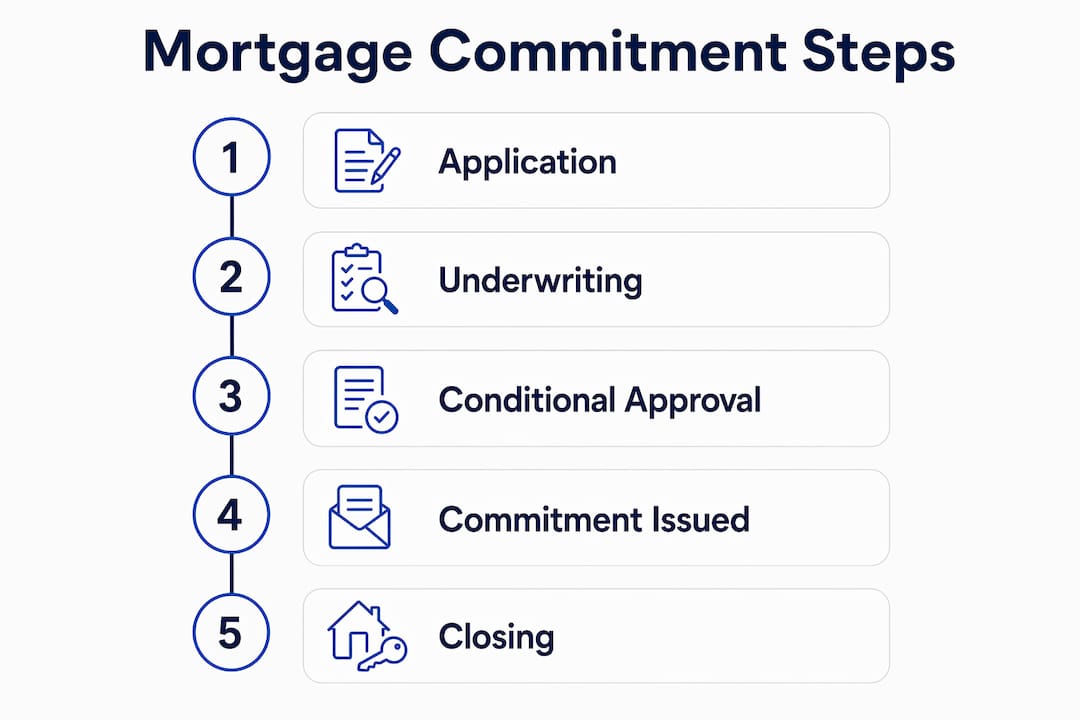
The path from application to commitment follows a defined sequence, and knowing each step helps you move through it faster. Here is how the process typically unfolds for Florida borrowers:
- Submit your mortgage application. You provide income documentation, tax returns, bank statements, employment history, and consent for a credit pull. Your lender at Platinumcapitalfinancial or another Florida broker collects this file and prepares it for underwriting.
- Underwriting begins. The underwriter reviews your credit score, debt-to-income ratio, employment stability, and asset reserves. This is the most detailed financial review in the entire mortgage approval process and typically takes 5 to 10 business days for a standard file.
- Property appraisal is ordered. The lender orders an independent appraisal to confirm the home's market value. In Florida, appraisal timelines can stretch in high-demand counties like Collier or Sarasota, so ordering early matters.
- Conditional approval is issued. Once underwriting completes its initial review, conditional approval is issued. The lender has reviewed the application but requires specific documents or verifications before final approval.
- You satisfy the conditions. You gather and submit every item on the conditions list. Speed here is critical. Buyers who respond to condition requests within 24 to 48 hours consistently close faster than those who wait.
- Firm commitment is issued. Once all conditions are cleared, the lender issues a firm commitment letter. This document confirms the loan is approved and ready to move toward closing.
- Clear to close is granted. Clear to close means all requirements in the commitment letter have been satisfied and the lender has approved the loan for disbursement. This is the final green light before the actual closing date.
Florida’s real estate contracts often include a mortgage contingency deadline, typically 21 to 30 days after the contract is signed. Missing that deadline can put your earnest money deposit at risk, which makes moving quickly through steps one through five non-negotiable.
What is the difference between pre-approval, commitment, and clear to close?
These three terms describe three different levels of lender confidence, and confusing them is one of the most common mistakes Florida homebuyers make. The table below breaks down each stage clearly.
Pre-approval is the starting point. It tells you what you can likely borrow and signals to sellers that you are a serious buyer. The commitment letter is a much deeper evaluation, and it signals strong likelihood of loan funding if conditions are met. Clear to close is the finish line before closing day.
For Florida buyers negotiating in competitive markets, understanding this progression helps you set realistic timelines. A seller who asks for proof of financing wants a commitment letter, not just a pre-approval. Knowing the difference protects you at the negotiation table.
What risks should Florida borrowers watch for after receiving a commitment?
Receiving a commitment letter does not mean the loan is locked in permanently. Lenders can revoke a mortgage commitment if a borrower’s financial situation changes materially, such as an income reduction, a credit score drop, or new debt acquisition. The commitment is conditional on financial consistency until closing.
The most common risks Florida borrowers face after receiving a commitment include:
- Taking on new debt. Financing a car, opening a new credit card, or co-signing a loan between commitment and closing can raise your debt-to-income ratio enough to void the approval.
- Job changes. Switching employers, even for a higher salary, triggers a new employment verification. Lenders treat a probationary period at a new job as a risk factor.
- Large undocumented deposits. Moving money between accounts without a paper trail raises underwriting flags during the final review.
- Appraisal shortfalls. If the home appraises below the purchase price, the lender will only fund up to the appraised value. You will need to renegotiate the price, cover the gap in cash, or walk away.
- Title issues. Outstanding liens, boundary disputes, or unresolved estate claims on a Florida property can delay or kill a closing even after commitment is issued.
Pro Tip: Treat the period between your commitment letter and closing like a financial freeze. Pay your bills on time, avoid new credit applications, and do not make any large purchases. Time limits on commitment letters require buyers to satisfy lender conditions quickly to avoid delays and renegotiations, especially in fluctuating markets.
Protecting your earnest money deposit is another reason to take these risks seriously. Florida real estate contracts include financing contingency clauses that protect buyers if financing falls through for reasons outside their control. But if a commitment is revoked because you took on new debt voluntarily, that protection may not apply.
Key takeaways
A mortgage commitment is the strongest formal signal a lender sends before funding, and satisfying its conditions quickly is the single most important action a Florida homebuyer can take to protect their closing timeline.
What I have learned about mortgage commitments in Florida’s market
I have worked with Florida homebuyers across every price range and market cycle, and the pattern I see most often is this: buyers treat the commitment letter as the finish line when it is actually the starting gun for the most critical phase of the transaction.
The biggest mistake is passivity. A buyer receives their conditional commitment, feels relieved, and then waits. Meanwhile, the clock on that letter is running. In markets like Southwest Florida where closing timelines are tight and sellers have options, a buyer who takes two weeks to respond to a condition request is a buyer who risks losing the deal.
The second mistake is underestimating how closely lenders monitor your financial behavior between commitment and closing. I have seen buyers lose their commitment letter because they financed furniture for the new home before the loan funded. The lender pulled a soft credit check three days before closing, saw the new installment account, and the debt-to-income ratio no longer qualified. That is a painful and entirely avoidable outcome.
My advice to every Florida buyer is to treat the commitment letter as a contract with yourself. Read every condition. Respond to every request within 24 hours. Do not touch your credit. And stay in close contact with your mortgage broker and real estate agent so that nothing falls through the cracks between underwriting and the closing table.
Florida’s real estate market in 2026 rewards prepared buyers. A clean, fast path from commitment to closing is not luck. It is preparation.
— Chuck Barnes
Get your mortgage commitment with Platinumcapitalfinancial
Platinumcapitalfinancial works with Florida homebuyers to move from application to commitment letter as efficiently as possible. Whether you are purchasing with a fixed-rate mortgage in Collier County, exploring FHA or VA loan options, or refinancing an existing property, the team at Platinumcapitalfinancial understands the local market conditions that affect your timeline and terms. Getting the right guidance before you submit your application makes every step after it faster and cleaner. Connect with Platinumcapitalfinancial today to start your Florida home financing with a team that knows how to get you to closing.
FAQ
What is a mortgage commitment letter?
A mortgage commitment letter is a formal document from your lender stating their intent to fund your home loan, typically after underwriting has reviewed your credit, income, assets, and the property. It may be conditional, requiring additional steps, or firm, meaning the lender is ready to proceed to closing.
How long does it take to get a mortgage commitment in Florida?
Most Florida borrowers receive a conditional commitment within 10 to 21 days of submitting a complete application, depending on how quickly the appraisal is completed and how fast the borrower responds to underwriting requests.
What is the difference between pre-approval and a mortgage commitment?
Pre-approval is based on a preliminary review of your stated financial information, while a mortgage commitment follows a full underwriting review of verified documents and a property appraisal. The commitment reflects a much higher level of lender confidence.
Can a lender cancel a mortgage commitment after it is issued?
Yes. Lenders can revoke a commitment if your financial situation changes materially before closing, including a drop in credit score, new debt, job loss, or a failed property appraisal. Maintaining financial stability between commitment and closing is critical.
Do I need a mortgage commitment letter to make an offer in Florida?
You do not need one to make an offer, but having a commitment letter strengthens your position significantly. It satisfies financing contingency clauses in purchase contracts and signals to sellers that your financing is substantially secured, which matters in competitive Florida markets.
Recommended
- What Is Mortgage Lock? a Florida Buyer's Guide
- What Is a Mortgagee? a Guide for Homebuyers
- What is mortgage origination? Florida homebuyer's guide
- Mortgage term explained: A clear guide for Florida buyers
Get a free instant rate quote
Take a first step towards your dream home

Free & non binding
No documents required
No impact on credit score
No hidden costs
.svg)
.svg)
.svg)
.svg)

.svg)
