
.svg)
Mortgage News
What Is Mortgage Payoff? A Clear Guide for Homeowners
Mortgage payoff is defined as the exact total amount you must pay to fully satisfy and close your home loan. This figure is not the same as the balance shown on your monthly statement. Your payoff amount includes your remaining principal, all interest accrued up to the payoff date, and any outstanding fees or charges. Federal regulations require mortgage servicers to provide an accurate payoff statement within seven business days of a written request. Understanding the difference between your statement balance and your true payoff amount is the first step to closing your mortgage without delays or rejected payments.
What is mortgage payoff, and how does it differ from your balance?
The monthly balance on your mortgage statement is a snapshot. It reflects what you owed on the date your servicer generated that statement, which is often two to four weeks before you even read it. Your statement balance is insufficient to pay off the loan because interest accrues every single day after that date.
Your mortgage payoff amount, by contrast, is a precise figure calculated for a specific future date. It accounts for every dollar of principal still owed, every day of interest that will accumulate between now and your chosen payoff date, and any fees your servicer is entitled to collect. Sending the statement balance instead of the official payoff amount is one of the most common and costly mistakes homeowners make when trying to close a loan.

The industry term for the document that states this figure is a payoff statement or payoff quote. You may also hear it called a mortgage payoff letter. All three terms refer to the same legally binding document your servicer produces upon request.
What components make up a mortgage payoff amount?
The payoff amount has three core layers: principal, accrued interest, and fees. Each one adds to the total, and each one is calculated differently.
Principal balance
The principal balance is the baseline. It is the remaining loan amount you have not yet repaid, excluding any interest. This number decreases with every on-time payment you make, but it is never the whole story when it comes to payoff.
Accrued daily interest
U.S. mortgages accrue interest in arrears, meaning you pay last month’s interest with each monthly payment. Between your last payment and your payoff date, interest keeps building every day. The daily rate is calculated by dividing your annual interest rate by 365. On a $200,000 balance at 6% interest, that works out to roughly $32.87 per day. If your payoff date is 20 days after your last payment, you owe an additional $657.40 in interest alone.
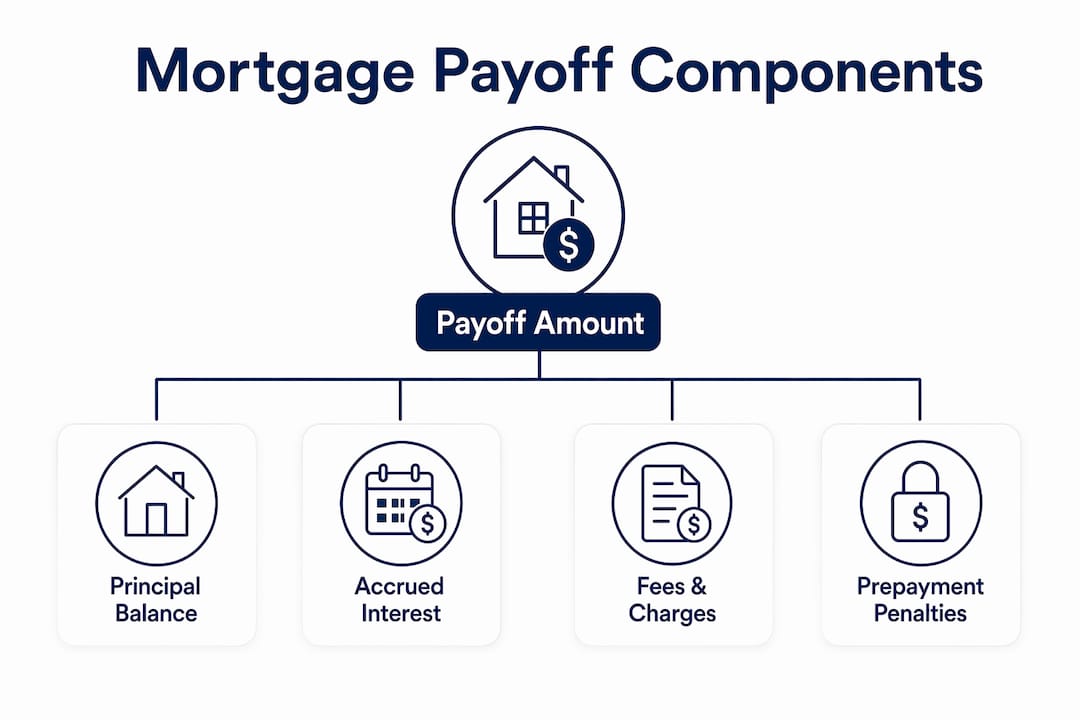
Fees and other charges
Servicers may add several fees to the payoff total. Common additions include administrative fees, recording fees for the lien release, any unpaid late fees, and in some cases, prepayment penalties. Payoff statements typically include administrative fees ranging from $0 to $30, depending on the servicer.
Pro Tip: Ask your servicer directly whether your loan carries a prepayment penalty before you request a payoff statement. Some older loan types still include this clause, and it can add hundreds of dollars to your total.
How do you request a mortgage payoff statement?
The process is straightforward, but the details matter. A verbal request carries no legal weight. Only a formal written request triggers your servicer’s legal obligation to respond within seven business days.
- Choose your request method. Most servicers accept written requests through their online portal, by mail, by fax, or by email. Online portals are the fastest option for most homeowners.
- Specify a realistic "good through" date. This is the date through which your payoff amount will remain valid. Choose a date that gives you enough time to gather funds and complete the transfer, typically 15 to 30 days out.
- Include proper authorization. If a title company or closing attorney is handling the request on your behalf, use a CFPB third-party authorization form. This form is industry best practice and reduces errors that can delay closings.
- Confirm receipt. Follow up to confirm your servicer received the request. Seven business days is the legal maximum, but many servicers respond faster.
- Review the statement carefully. Check that the principal balance, per diem interest rate, fees, and "good through" date all look accurate before you send any funds.
Pro Tip: Request your payoff statement at least three weeks before your intended closing or payoff date. This gives you time to catch errors and request corrections without missing your deadline.
Why does the “good through” date matter so much?
The “good through” date is the expiration date printed on your payoff statement. It is the last day your servicer must accept the quoted amount as full payment. Payoff quotes are typically valid for 10 to 30 days. After that date, the quote expires and you need a new one.
Missing the “good through” date creates real problems:
- Your payment may be rejected outright.
- You will need to request a new payoff statement, which restarts the seven-business-day clock.
- If you are in the middle of a home sale or refinance, a missed deadline can delay your closing.
- Additional daily interest continues to accrue, increasing your total owed.
The safest way to avoid these problems is to pay slightly more than the quoted amount. Including a small buffer based on the per diem interest rate covers any extra days that may pass during processing. Overpayments are refunded after your account closes, so you lose nothing by padding the amount.
Wire transfers are the preferred payment method for mortgage payoffs. They settle the same day and provide immediate confirmation that funds were received. Domestic wire transfers typically cost between $10 and $30, which is a small price compared to the risk of a delayed or rejected payment.
What happens after you pay off your mortgage?
Paying off your mortgage triggers a series of steps that do not happen automatically. You need to follow up on each one.
- Lien release. Your lender must file a lien release with your county recorder's office to remove their claim on your property. This process can take several weeks. Confirm it has been filed and request a copy for your records.
- Escrow refund. If your loan included an escrow account for property taxes and homeowners insurance, your servicer will refund any remaining balance. This typically arrives within 20 business days of payoff.
- Credit bureau update. Your servicer will notify the major credit bureaus that the loan is paid in full. This update can take several weeks to appear on your credit report. A paid-off mortgage generally has a positive long-term effect on your credit profile.
- Property taxes and insurance. Once your escrow account closes, you are responsible for paying property taxes and homeowners insurance directly. Set up reminders or automatic payments so you do not miss a due date.
- Account closure confirmation. Request written confirmation from your servicer that the account is closed and the balance is zero. Keep this document permanently.
Key Takeaways
The mortgage payoff amount is always higher than your statement balance because daily interest and fees accumulate between your last payment and your actual payoff date.
What I have learned from watching homeowners navigate payoff
The most expensive mistake I see is homeowners treating their monthly statement balance as the payoff number. They send that amount, the servicer rejects it, and suddenly a clean closing turns into a two-week scramble. The monthly balance is a reference point, not a legal payoff figure. These are two completely different numbers, and confusing them costs real money.
The second mistake is waiting too long to request the payoff statement. Seven business days sounds fast, but add in weekends, holidays, and internal processing delays, and you can easily burn through two weeks before the document arrives. Request it early. Give yourself a cushion.
The third thing I always tell homeowners: do not rely on a verbal quote from your servicer. I have seen homeowners call their lender, get a number over the phone, wire that amount, and then receive a rejection notice because the verbal figure did not account for fees or the correct per diem calculation. A verbal payoff quote holds no legal weight. Only the written statement is binding.
If you are working with a title company or closing attorney, make sure they use the CFPB third-party authorization form when requesting the payoff on your behalf. This one step eliminates most of the authorization errors that delay closings. It is a small administrative task that prevents a large headache.
— Chuck Barnes
Platinumcapitalfinancial can guide you through the payoff process
Paying off a mortgage or refinancing into a better loan requires accurate information and the right support. Platinumcapitalfinancial works with homeowners across Florida to clarify payoff figures, review loan terms, and identify refinancing options that may reduce your total cost.

Whether you are preparing to pay off your current loan or exploring a Florida home loan that better fits your financial goals, Platinumcapitalfinancial’s licensed mortgage brokers provide clear, personalized guidance at every step. Contact Platinumcapitalfinancial today to get accurate answers about your payoff options and what comes next.
FAQ
What is a mortgage payoff amount?
A mortgage payoff amount is the total sum required to fully satisfy your home loan on a specific date. It includes your remaining principal, all accrued daily interest, and any applicable fees.
What is a mortgage payoff letter?
A mortgage payoff letter, also called a payoff statement or payoff quote, is a legally binding document from your servicer that states the exact amount needed to close your loan by a specific date.
How do I request a payoff statement?
Submit a formal written request to your servicer through their online portal, by mail, by fax, or by email. Federal law requires your servicer to respond within seven business days.
What happens if I miss the “good through” date?
Your payment may be rejected, and you will need to request a new payoff statement. Missing this deadline can also delay a home sale or refinance closing.
Does paying off my mortgage hurt my credit?
Paying off a mortgage typically has a positive long-term effect on your credit. The account will be marked as paid in full, though the update may take several weeks to appear on your credit report.
Recommended
- What Is a Mortgagee? a Guide for Homebuyers
- Mortgage term explained: A clear guide for Florida buyers
- Mortgage Points Calculator Break Even Buy Down Guide
- What Is Mortgage Insurance? A Homebuyer's Guide
Get a free instant rate quote
Take a first step towards your dream home

Free & non binding
No documents required
No impact on credit score
No hidden costs
.svg)
.svg)
.svg)
.svg)

.svg)
