
.svg)
Mortgage News
Florida Fixer Upper Loan Options for Buyers in 2026
Florida fixer upper loan options are specialized mortgage programs that combine home purchase and renovation costs into a single loan, eliminating the need for separate financing. The two leading programs are the FHA 203(k) and the Fannie Mae HomeStyle Renovation loan, each serving different buyer profiles and renovation scopes. Florida buyers benefit from county-specific loan limits that reach up to $1,249,125 for single-family homes in high-cost areas in 2026. Understanding which program fits your credit score, renovation budget, and occupancy plans is the fastest way to avoid costly mistakes before you ever break ground.
1. What are Florida fixer upper loan options?
Fixer upper financing in Florida refers to renovation mortgages that roll purchase price and repair costs into one loan. The industry terms are “renovation loans” or “rehabilitation mortgages.” These programs exist because standard purchase loans do not fund repairs, leaving buyers to scramble for separate contractor financing after closing.
The two dominant programs in Florida are the FHA 203(k) and the Fannie Mae HomeStyle Renovation loan. Both let you borrow against the home’s projected “as-completed” value rather than its current condition. That distinction matters because it unlocks more borrowing power than a traditional appraisal would allow.
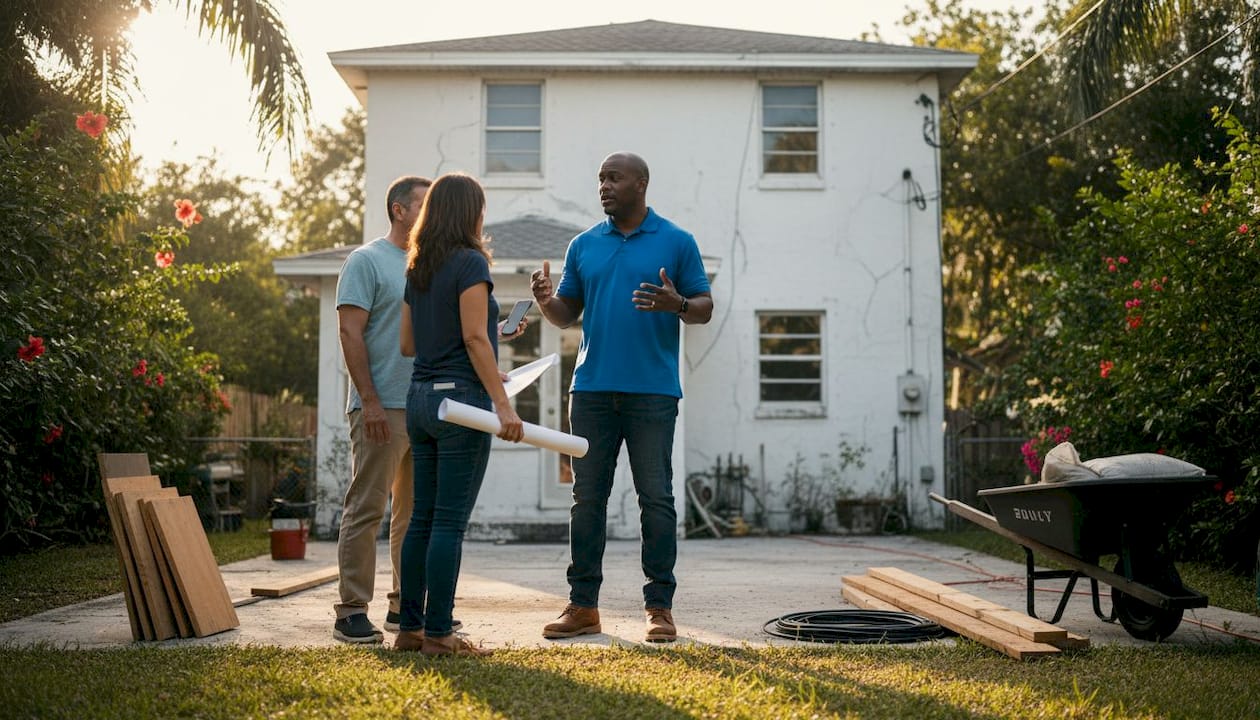
Florida’s active real estate market makes these loans especially relevant. Older housing stock in markets like Tampa Bay, Orlando, and South Florida often needs significant work before it meets livable standards. Renovation loans let buyers compete for those properties without needing cash reserves to cover repairs separately.
2. How the FHA 203(k) loan works for Florida buyers
The FHA 203(k) is the most accessible renovation loan in Florida because it accepts lower credit scores and smaller down payments than conventional alternatives. Buyers with a 580 credit score qualify with 3.5% down. Buyers with scores between 500 and 579 qualify with 10% down.
The program splits into two versions:
- Limited 203(k): Covers non-structural repairs up to $75,000. No HUD consultant required. Best for cosmetic work like flooring, roofing, HVAC, and kitchen updates.
- Standard 203(k): Covers structural repairs with no cap on renovation costs beyond the loan limit. Requires a HUD-approved consultant who manages inspections and releases funds in stages from escrow.
Florida county loan limits in 2026 range from $541,287 in lower-cost counties to $1,249,125 in high-cost areas for single-family homes. That range means buyers in Collier County or Miami-Dade can finance significantly larger projects than buyers in rural North Florida.
The draw process for the Standard 203(k) works in stages. The HUD consultant inspects each completed phase before the lender releases the next tranche of funds. That structure protects both the lender and the borrower, but it requires contractors who understand the timeline and can manage cash flow between draws.
Pro Tip: Get contractor bids before you apply. Lenders use those bids to calculate the loan amount, and detailed, itemized bids produce higher appraisals.
3. Understanding Fannie Mae HomeStyle Renovation loans in Florida
The Fannie Mae HomeStyle Renovation loan is the conventional alternative to the FHA 203(k). It carries stricter credit requirements but offers more flexibility on property type and renovation scope.
Key features include:
- Eligible for primary residences, second homes, and investment properties
- Renovation costs capped at 75% of the as-completed appraised value
- No minimum renovation amount required
- Work must be completed within 15 months of loan closing
- Lenders fund up to 50% of renovation costs at closing to cover initial contractor fees
- DIY work allowed up to 10% of as-completed home value, with lender inspections required for work over $5,000
The HomeStyle loan does not cover luxury items or non-functional upgrades. Pools, outdoor kitchens, and similar amenities are excluded. The focus is on improvements that increase the home’s functional value and marketability.
HomeStyle requires a higher credit score than FHA 203(k), generally 620 or above, and a larger down payment for investment properties. That makes it the better fit for experienced investors and buyers with stronger financial profiles.
Pro Tip: If you plan to use HomeStyle on an investment property, confirm your lender actively originates this product. Not every lender in Florida handles the recourse risk that comes with HomeStyle delivery before renovation completion.
4. Key limitations and eligibility rules for renovation loans in Florida
Florida buyers frequently run into the same set of restrictions regardless of which program they choose. Knowing these upfront prevents wasted time and application fees.
- Owner occupancy for FHA 203(k). The FHA 203(k) requires the borrower to occupy the property as a primary residence. Mortgage fraud audits are common in Florida's active market for misuse of this rule. Investors who use FHA 203(k) to flip properties face serious legal exposure.
- Excluded renovation types. Both FHA 203(k) and HomeStyle exclude luxury and non-functional items such as pools, outdoor kitchens, and decorative landscaping. Repairs must improve the home's habitability or structural integrity.
- Debt-to-income ratio. FHA products generally cap the debt-to-income ratio at 43%. Buyers with high existing debt loads may not qualify even if their credit score meets the threshold.
- Contractor documentation. Both programs require licensed contractors for major work. Bids must be itemized and detailed. Vague estimates cause appraisal discrepancies and loan reductions.
- Loan limits by county. Florida's 2026 limits vary significantly by county. Buyers in high-cost coastal counties access much larger loan amounts than buyers in inland or rural areas.
- DIY restrictions. FHA 203(k) heavily limits DIY work. HomeStyle permits it up to 10% of as-completed value, but lender inspections are mandatory for any work exceeding $5,000.
- Draw and inspection timelines. Funds release in stages after inspections, not upfront. Contractors must be willing to work within that structure, which not all Florida contractors accept.
5. How to choose the right renovation loan for your goals
Matching the right loan to your situation comes down to three factors: your credit profile, your renovation scope, and your occupancy plan.
Credit score and down payment
Buyers with credit scores below 620 should focus on the FHA 203(k). The 3.5% down payment requirement makes it the most accessible entry point for first-time buyers and those with limited cash reserves. Buyers with scores above 620 and larger down payments gain access to HomeStyle, which carries no mortgage insurance premium at the same level as FHA.
Renovation scope
Small cosmetic projects under $75,000 fit the Limited 203(k) well. Structural work, additions, or full gut renovations require the Standard 203(k) or HomeStyle. HomeStyle has no renovation floor, so it works for both minor and major projects as long as total costs stay within 75% of as-completed value.
Occupancy and investment goals
FHA 203(k) is strictly for owner-occupants. If you plan to rent the property immediately after renovation, HomeStyle is the only renovation mortgage that allows it. Borrowers with lower credit scores benefit most from FHA 203(k), while investors may prefer HomeStyle if they meet the eligibility requirements.
Pro Tip: Appraisers use as-completed value to set your loan amount. Discrepancies between contractor bids and appraiser estimates directly reduce what you can borrow. Align your bids with the appraiser’s scope before submission.
6. Alternative renovation financing options in Florida
Not every buyer fits the FHA 203(k) or HomeStyle mold. Several other programs and products serve specific buyer profiles.
- VA Renovation loans. Eligible veterans and active-duty service members can access renovation financing with zero down payment. VA renovation loans combine purchase and repair costs similarly to FHA 203(k) but without mortgage insurance premiums. Florida has a large veteran population, making this an underused option worth exploring through a VA mortgage broker.
- Home equity lines of credit (HELOC). Existing homeowners with built-up equity can fund renovations through a HELOC without refinancing their primary mortgage. This works well for smaller projects where the renovation cost does not justify a full loan restructure.
- Conventional renovation loans. Some lenders offer portfolio renovation products outside of FHA or Fannie Mae guidelines. These typically require higher credit scores and larger down payments but offer more flexibility on property type and renovation scope.
- Personal loans and cash financing. For projects under $30,000, personal loans or cash reserves may be faster and simpler than a renovation mortgage. The trade-off is a higher interest rate and shorter repayment term.
- Construction loans. For properties requiring near-total rebuilds, a construction financing product may be more appropriate than a renovation loan. Construction loans fund in draws as work progresses and convert to a permanent mortgage at completion.
The right alternative depends on your equity position, credit profile, and how quickly you need funds available.
Key takeaways
Florida fixer upper loan options work best when buyers match their credit profile, renovation scope, and occupancy plan to the right program before applying.
What I’ve learned from watching Florida buyers get renovation loans wrong
Chuck Barnes here. After years of watching buyers navigate renovation financing in Florida, the single biggest mistake I see is underestimating total loan costs before applying.
FHA mortgage insurance premiums and consultant fees add up fast. Buyers budget for the renovation but forget those costs eat into the loan proceeds. The result is a financing shortfall mid-project, which stalls construction and strains contractor relationships.
The second mistake is contractor selection. Florida has no shortage of contractors willing to take a job, but renovation loan contractors need to understand draw schedules, inspection requirements, and HUD consultant coordination. Hiring a contractor who has never worked with a 203(k) loan is a reliable way to blow your timeline.
My honest advice: engage your lender before you make an offer. Not after. A good mortgage broker will tell you which program fits your profile, what your realistic loan amount looks like, and which contractors in your area have a track record with renovation loans. That conversation takes 30 minutes and can save you months of frustration.
Florida’s market moves fast. Buyers who show up pre-qualified for a renovation loan with contractor bids in hand close deals that other buyers lose.
— Chuck Barnes
Platinumcapitalfinancial helps Florida buyers finance fixer uppers
Platinumcapitalfinancial works with Florida homebuyers and investors to find the right renovation loan for their specific situation.

Whether you need an FHA 203(k) for a primary residence, a HomeStyle loan for an investment property, or a VA renovation loan with zero down, Platinumcapitalfinancial has access to the programs and lenders that serve Florida’s diverse markets. The team handles the documentation, contractor bid review, and lender coordination that makes renovation financing complex for most buyers. If you are ready to move forward, connect with a Florida mortgage broker at Platinumcapitalfinancial to get matched with the right program before your next offer.
FAQ
Can I get a loan for a fixer upper in Florida?
Yes. The FHA 203(k) and Fannie Mae HomeStyle Renovation loans both allow Florida buyers to finance purchase and renovation costs in a single mortgage. Eligibility depends on credit score, down payment, and occupancy plans.
What credit score do I need for an FHA 203(k) loan in Florida?
A score of 580 qualifies you for 3.5% down. Scores between 500 and 579 require 10% down. Scores below 500 are not eligible for FHA products.
Can investors use FHA 203(k) loans in Florida?
No. The FHA 203(k) requires owner occupancy as a primary residence. Using it for investment or rental properties violates occupancy rules and constitutes mortgage fraud under FHA guidelines.
What is the renovation cost limit for a HomeStyle loan?
Renovation costs cannot exceed 75% of the home’s as-completed appraised value. There is no minimum renovation amount, and work must be completed within 15 months of closing.
What are the Florida FHA loan limits for 2026?
Florida’s 2026 FHA loan limits for single-family homes range from $541,287 in lower-cost counties to $1,249,125 in high-cost areas. Your county determines which limit applies to your loan.
Recommended
- Florida Construction Financing & Home Building Loan Options
- Florida FHA 203k Loan for Home Purchase & Renovation
- Why Buy in Florida: Top Reasons for 2026 Buyers
- Best mortgage types for Florida first-time homebuyers
Get a free instant rate quote
Take a first step towards your dream home

Free & non binding
No documents required
No impact on credit score
No hidden costs
.svg)
.svg)
.svg)
.svg)

.svg)
