
.svg)
Mortgage News
Florida Conventional Loans Comparison: 2026 Buyer's Guide
Conventional loans are the most common mortgage choice for Florida homebuyers, and for good reason. A conventional loan is a private mortgage not insured or guaranteed by any government agency. Instead, it follows standards set by Fannie Mae and Freddie Mac, the two government-sponsored enterprises that buy and securitize most conforming mortgages in the U.S. That structure gives lenders flexibility to offer competitive rates, and it gives you a path to eliminate mortgage insurance entirely once you build enough equity, something government-backed loans often don’t allow.

The typical Florida buyer who benefits most from a conventional loan has a credit score of 620 or above, stable income, and a manageable debt load. Programs like HomeReady and HomeStyle, both backed by Fannie Mae, open the door to low down payment options starting at 3%, making conventional financing accessible even without a large cash reserve. The Homeowners Protection Act governs when your private mortgage insurance (PMI) must be canceled, giving you legal protections that FHA loans simply don’t match.
Core features of Florida conventional loans at a glance:
- Not insured by FHA, VA, or USDA
- Governed by Fannie Mae and Freddie Mac guidelines
- Minimum credit score typically 620
- Down payments as low as 3% with qualifying programs [3% down payment options starting]
- PMI is removable once you reach 80% loan-to-value (LTV)
- 2026 baseline conforming loan limit for most Florida counties
- Available for primary residences, second homes, and investment properties
Platinumcapitalfinancial works with Florida buyers across all these loan types, helping you match the right product to your situation with licensed NMLS guidance.
What are the eligibility requirements for a conventional loan in Florida?
Your credit score is the first number lenders look at, and 620 is the floor, not the target. Scores above 740 tend to unlock the best interest rates and the lowest PMI costs. Getting from 620 to 740 before you apply can meaningfully reduce what you pay every month.
Stable income and DTI requirements are equally firm. Lenders generally want your total debt-to-income ratio below 45%, though some automated underwriting systems will approve up to 50% in strong files. That ratio includes your new mortgage payment, car loans, student debt, credit cards, and any other recurring obligations.
Beyond the Fannie Mae and Freddie Mac baseline, individual lenders often impose their own overlays. A lender overlay is an internal rule that is stricter than the agency guideline. One lender might require a 640 minimum score where the agency allows 620; another might cap DTI at 43% regardless of what the automated system approves. Shopping multiple lenders matters precisely because of this variation.
Eligibility checklist for Florida conventional loans:
- Credit score of at least 620 (higher scores usually improve pricing)
- Verifiable income through W-2s, tax returns, or bank statements
- Stable employment history, typically two years in the same field
- DTI ratio generally below 45%, with some flexibility to 50%
- Down payment of at least 3% for qualifying programs, or 5–20%+ for standard loans
- Property must meet Fannie Mae or Freddie Mac appraisal standards
Pro Tip: Before you apply, pull your credit report from all three bureaus and dispute any errors. A single incorrect collection account can suppress your score by 30–50 points, which could push you into a higher PMI tier or a worse rate.
How much does a conventional loan cost in Florida?
Down payment size drives most of the cost conversation. Put down 20% and you skip PMI entirely. Put down less, and PMI kicks in until you reach 80% LTV, at which point you can request cancellation in writing. Under the Homeowners Protection Act, servicers must automatically terminate PMI when your balance hits 78% of the original home value, provided you’re current on payments.

PMI costs range from 0.46% to 1.5% of the loan amount annually, depending on your credit score and loan specifics. On a $500,000 loan, that’s roughly $2,300 to $7,500 per year. A borrower with a 760 score pays closer to the low end; a borrower at 640 pays closer to the high end.
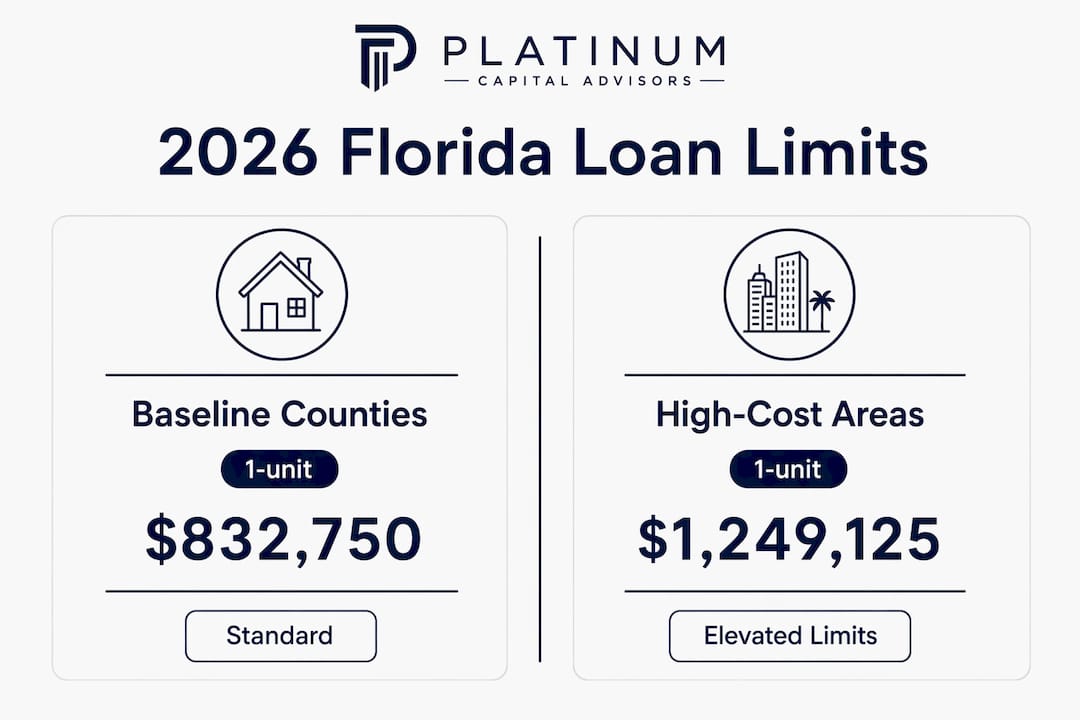
for a single-unit property in most Florida counties is $832,750. High-cost Florida areas can go up to $1,249,125. Any loan above these thresholds becomes a jumbo loan, which carries different pricing and stricter qualification standards.
Upfront costs also include origination fees, appraisal fees, title insurance, and prepaid items like homeowners insurance and property taxes. Florida’s documentary stamp tax on mortgages adds to closing costs as well. Budget roughly 2–5% of the loan amount for total closing costs, though your Loan Estimate will show the exact figures for your transaction.
Conventional vs. FHA loans in Florida: which one fits your situation?
The conventional vs. FHA decision comes down to three things: your credit score, how long you plan to stay in the home, and how much you can put down. FHA loans accept scores as low as 580 with 3.5% down, making them accessible to buyers who can’t yet qualify for conventional financing. But that accessibility comes at a price.
FHA loans carry both an upfront mortgage insurance premium (MIP) and an annual MIP that, for most borrowers, lasts the life of the loan. Conventional PMI disappears once you hit 80% LTV. Over a 30-year loan, that difference in mortgage insurance costs can add up to tens of thousands of dollars.
FHA loans also restrict you to primary residences. If you’re buying a vacation home on Florida’s Gulf Coast or a rental property in Orlando, conventional is your only conforming option. You can explore FHA loan details if you’re still weighing both paths.
VA loans are worth mentioning for eligible veterans and active-duty service members. They require no down payment and no PMI, which beats both conventional and FHA on upfront cost. USDA loans serve rural Florida buyers with similar no-down-payment benefits. But for most Florida homebuyers without VA eligibility buying in suburban or urban markets, the conventional vs. FHA comparison is the real decision.
What are the 2026 conventional loan limits for Florida counties?
The Federal Housing Finance Agency (FHFA) sets conforming loan limits annually under the Housing and Economic Recovery Act formula. For 2026, the baseline limit for a one-unit property is $832,750 across most of Florida. A handful of high-cost counties carry elevated limits up to $1,249,125.
Any loan that exceeds the applicable limit for your county becomes a jumbo loan. Jumbo loans are still conventional in the sense that they’re not government-backed, but they don’t conform to Fannie Mae and Freddie Mac purchase guidelines. That means stricter underwriting, higher reserves requirements, and often higher rates. If your purchase price puts you near the limit, it’s worth running the numbers on whether a slightly larger down payment keeps you inside conforming territory.
Florida’s median home prices in markets like Miami, Naples, and the Florida Keys push many buyers toward the conforming ceiling. Knowing your county’s exact limit before you start shopping prevents surprises late in the process.
What types of conventional loans are available in Florida?
Not all conventional loans are the same product. The right one depends on your down payment capacity, the property you’re buying, and whether you need to finance improvements.
- Standard conforming loan: The baseline product. Fixed or adjustable rate, up to the county loan limit, with standard credit and income requirements. Best for buyers with solid credit and a 5–20% down payment.
- HomeReady Loan: A Fannie Mae program designed for low-to-moderate income buyers. Accepts 3% down, allows income from non-borrower household members to count toward qualification, and offers reduced PMI rates for eligible borrowers. Particularly useful in Florida's high-cost coastal markets where buyers often have strong income but limited savings.
- HomeStyle Loan: Also from Fannie Mae, this product lets you finance both the purchase price and renovation costs in a single loan. If you're buying a fixer-upper in a competitive Florida neighborhood, HomeStyle can cover up to the lesser of the purchase price plus renovation costs or 75% of the as-completed appraised value. It works for primary residences, second homes, and investment properties.
- Jumbo conventional loan: For purchases above the conforming limit. Requires stronger credit, larger reserves, and often a higher down payment. Rates can be competitive with conforming loans depending on market conditions, but qualification is tighter.
Florida’s housing market has seen growing interest in accessory dwelling units (ADUs) as buyers look for ways to offset mortgage costs with rental income. Florida ADU legislation is expanding options for homeowners, and conventional loans can finance properties with ADUs under standard guidelines.
How do you apply for a conventional loan in Florida?
The application process moves faster when you’re organized upfront. Lenders need to verify your income, employment, assets, and credit before they can issue a Loan Estimate, and gaps in documentation are the most common cause of delays.
Essential documents to gather before applying:
- Two years of W-2s and federal tax returns
- Recent pay stubs (last 30 days)
- Two to three months of bank and investment account statements
- Government-issued ID
- Landlord contact information if you currently rent
- Documentation for any large deposits in your accounts
The application timeline, step by step:
- Pre-approval: Submit your financial documents and get a written pre-approval letter. This tells sellers you're a serious buyer and gives you a realistic price range.
- Loan application: Once you have a signed purchase contract, your lender opens a formal application file.
- Loan Estimate: Under the 3-7-3 rule, your lender must deliver a Loan Estimate within three business days of receiving your application. You then have a seven-business-day waiting period before closing can occur. If the APR changes by more than the allowed threshold, a new three-day waiting period begins.
- Appraisal and underwriting: The lender orders an appraisal to confirm the property's value. Underwriting reviews your full file against Fannie Mae or Freddie Mac guidelines.
- Closing Disclosure: You receive this at least three business days before closing, showing final loan terms and costs.
- Closing: Sign documents, pay closing costs, and receive your keys.
From pre-approval to closing, a conventional loan in Florida typically takes 30–45 days, though well-prepared buyers with clean files can close faster.
How Florida’s housing market shapes your conventional loan decision
Florida’s housing market in 2026 remains one of the most active in the country, with persistent demand from domestic migrants, retirees, and international buyers. That demand has kept home prices elevated in most metro markets, which directly affects how conventional loan limits interact with purchase prices.
In markets like Miami-Dade, Broward, and Palm Beach counties, median prices have pushed many buyers toward the upper end of conforming limits or into jumbo territory. Buyers in these markets benefit from knowing their county’s exact limit before they make an offer, since a loan that exceeds the conforming ceiling by even a small amount triggers jumbo underwriting requirements.
Florida’s insurance market adds a layer of cost that affects debt-to-income calculations. Homeowners insurance premiums in coastal counties have risen sharply, and lenders include insurance in your monthly payment for DTI purposes. A buyer who qualifies comfortably in an inland county might find their DTI stretched in a coastal market simply because of insurance costs. Running your numbers with realistic insurance estimates, not just the lender’s placeholder, gives you a more accurate picture of what you can afford.
Interest rate sensitivity also plays out differently in Florida than in slower markets. When rates rise, Florida’s competitive bidding environment doesn’t always soften the way it does elsewhere, because cash buyers and investors remain active. That means rate shopping and locking strategically matters more here. Working with a Florida mortgage broker who knows the local market can help you time your rate lock and structure your offer competitively.
Key Takeaways
Conventional loans in Florida offer the most flexible long-term financing for qualified buyers, with removable PMI, competitive rates, and conforming limits reaching $832,750 for most counties in 2026. High-cost Florida areas may have elevated limits up to $1,249,125.
Recommended
- VA vs Conventional Loans in Collier County Florida 2026 Comparison
- Jumbo vs Conventional Loans in Collier County
- Florida first-time homebuyer mortgage guide: your roadmap
- FHA vs Conventional Loans in Naples Payment Differences
Get a free instant rate quote
Take a first step towards your dream home

Free & non binding
No documents required
No impact on credit score
No hidden costs
.svg)
.svg)
.svg)
.svg)

.svg)
