
.svg)
Mortgage News
What Is Closing Costs? A Florida Buyer's Guide
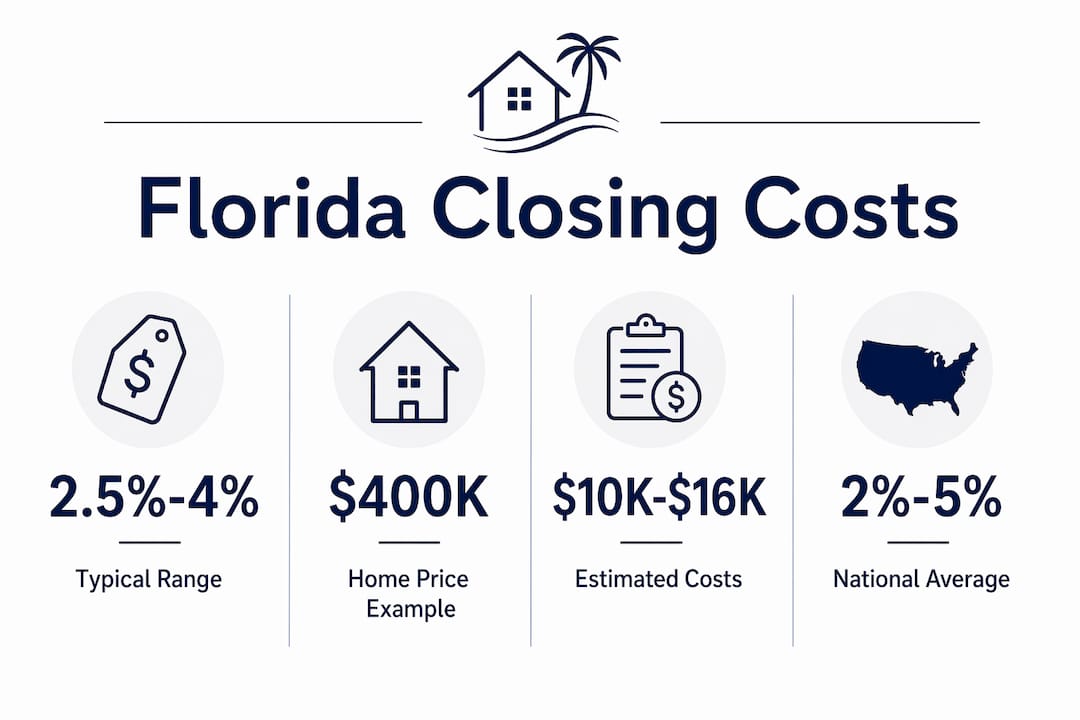
Closing costs are the fees and prepaid expenses buyers pay to finalize a home purchase, separate from the down payment. According to Freddie Mac, these charges come from your lender, real estate agents, and third-party service providers involved in completing the transaction. For Florida buyers, closing costs typically run between 2.5% and 4.0% of the purchase price, meaning a $400,000 home can require $10,000 to $16,000 in additional cash at closing. Understanding what these costs include, how they are calculated, and where you can negotiate gives you real control over your home financing decisions before you ever sign a document.
What is closing costs and what fees are included?
Closing costs are best understood as transaction-finalization expenses, not a single lender fee. Freddie Mac’s guidance describes them as charges from your lender and third parties to fund and complete your loan. They fall into three distinct categories, and knowing each one prevents budget surprises.
Lender and loan-related fees
These are the costs your mortgage lender charges directly to process and approve your loan. Origination fees cover the administrative work of creating your loan. Underwriting fees pay for the lender’s review of your financial profile. Appraisal fees, typically $400 to $600 in Florida, verify the property’s market value before the lender commits to funding.
Third-party and government fees
Title insurance protects both you and your lender if ownership disputes arise after closing. In Florida, lender’s title insurance is required, and owner’s title insurance is strongly recommended. Recording fees are paid to the county to officially register the deed and mortgage. Florida also charges documentary stamp taxes on the deed and mortgage, which are government-imposed and non-negotiable.

Prepaid expenses
Prepaid expenses are the category that surprises most buyers. The Urban Institute describes prepaids as forward payments on costs you would owe anyway, not purely fees. For a $400,000 to $500,000 loan, prepaid expenses account for roughly half of the total closing costs. That means your cash-to-close can feel far higher than the headline percentage suggests.
Common prepaids in Florida include:
- Homeowners insurance: Typically paid 12 months in advance at closing
- Property tax escrow: Usually 2 to 4 months of taxes collected upfront
- Prepaid mortgage interest: Covers daily interest from your closing date through the end of that month
- Initial escrow deposit: Seeds your escrow account for future insurance and tax payments
Pro Tip: Close earlier in the month if you want to reduce your prepaid mortgage interest. Closing on the 5th means you prepay 25 days of interest. Closing on the 28th means you prepay only 3 days.
The table below summarizes typical closing cost line items for Florida buyers:
How much should Florida homebuyers expect to pay?
Florida buyers typically pay between 2.5% and 4.0% of the purchase price in closing costs, according to a Florida-specific closing cost guide. On a $400,000 home, that translates to $10,000 to $16,000 in total cash due at closing. This range is meaningful because it directly affects how much cash you need to have ready beyond your down payment.
Several factors drive where your costs land within that range:
- Loan type: FHA loans require an upfront mortgage insurance premium of 1.75% of the loan amount, which adds thousands to closing costs. VA loans eliminate private mortgage insurance but include a funding fee. Conventional loans carry neither, but may require private mortgage insurance in the monthly payment.
- Closing date: Because prepaid interest accrues daily, closing at the end of the month reduces this line item significantly.
- Property tax timing: Florida property taxes are paid in arrears. If you close mid-year, your escrow account may collect several months of taxes upfront, increasing your cash-to-close.
- Lender selection: Origination fees, underwriting fees, and discount points vary between lenders. Shopping at least three lenders can reveal meaningful differences.
- Seller concessions: Zillow notes that negotiating seller credits toward closing costs is a legitimate offer strategy, not just a budgeting tactic. Asking the seller to cover $5,000 in closing costs effectively reduces your cash requirement without changing the purchase price.
Zillow’s research confirms that buyers typically pay 2% to 5% of the purchase price nationally, with Florida sitting in the middle of that range due to state-specific taxes and insurance requirements.
How do closing costs affect your home financing decisions?
Closing costs directly shape how much cash you need on closing day and can influence which loan product makes the most sense for your situation. A buyer with $30,000 saved faces a very different decision if closing costs consume $12,000 of that amount versus $8,000.
Here are four ways closing costs affect your financing strategy:
- Cash-to-close calculation: Your total cash due at closing equals your down payment plus closing costs minus any seller credits or lender credits. Knowing this number early lets you plan your savings timeline accurately.
- Loan product selection: Some buyers choose slightly higher interest rates in exchange for lender credits that reduce upfront closing costs. This trade-off makes sense if you plan to sell or refinance within five years.
- Offer strategy: Freddie Mac confirms that buyers can negotiate for sellers to cover certain fees. In a buyer-friendly market, requesting 2% to 3% in seller concessions is realistic and common in Florida.
- Loan qualification: Rolling closing costs into the loan (where permitted) increases your loan balance and monthly payment, which affects your debt-to-income ratio and qualification limits.
Pro Tip: When you receive competing Loan Estimates from multiple lenders, compare only the lender-specific fees, not the total closing cost number. Prepaids and government fees are the same regardless of lender, so comparing totals can mislead you into choosing the wrong loan.
The Urban Institute’s analysis reinforces this point directly: separating lender costs from prepaids and government fees is the only accurate way to compare lenders on cost.
How to review your Loan Estimate and Closing Disclosure
Two federal documents govern your closing costs, and both carry legal weight. The Loan Estimate arrives within 3 business days of submitting your mortgage application, per NerdWallet’s explanation. It gives you an early projection of all fees and prepaid expenses so you can compare lenders before committing.
The Closing Disclosure is the final, legally binding version. Federal law requires your lender to deliver it at least 3 business days before closing, giving you time to review every line item. NerdWallet emphasizes that your decision-making should rely on the Closing Disclosure for final numbers, not the initial estimate.
When reviewing these documents, focus on the following:
- Section A (Origination charges): These are lender fees and are negotiable. Compare them directly between your Loan Estimate and Closing Disclosure to spot increases.
- Section B and C (Services): Title insurance, settlement fees, and appraisal costs appear here. Some are fixed; others can be shopped.
- Prepaids and escrow (Sections F and G): Verify that the number of months collected for taxes and insurance matches what your lender quoted.
- Cash to close (Page 3): This is the single most important number. Confirm the payment method your closing agent requires, whether a wire transfer, certified check, or cashier's check.
According to LegalClarity’s closing disclosure guide, treat the Closing Disclosure as your source of truth for cash-to-close. Small changes in your closing date can shift prepaid interest and escrow amounts, so the final document may differ from your Loan Estimate even when no fees changed.
If you spot a fee that increased beyond the allowed tolerance or a line item you do not recognize, contact your lender immediately. You have the right to ask for a written explanation of every charge before you sign.
Key takeaways
Closing costs in Florida typically run 2.5% to 4.0% of the purchase price, with prepaid expenses often accounting for half the total, making early document review and lender comparison the two most effective ways to control your cash-to-close.
What I’ve learned from watching Florida buyers get blindsided at closing
Most buyers I work with understand that closing costs exist. What catches them off guard is the prepaid column. They budget for 3% and then discover that homeowners insurance alone runs $2,400 in South Florida, property taxes require a 3-month escrow deposit, and prepaid interest adds another $600. Suddenly their $12,000 estimate becomes $16,500.
The fix is not complicated, but it requires asking the right question early. Before you make an offer, ask your mortgage broker for a full cash-to-close estimate that includes prepaids, not just lender fees. That single number tells you whether your savings are sufficient before you are emotionally committed to a property.
I also see buyers make the mistake of comparing lenders on total closing costs rather than lender-specific fees. One lender may show lower total costs simply because they estimated fewer months of tax escrow. That difference disappears at closing. What matters is origination fees, underwriting fees, and rate. Everything else is largely fixed by location and loan type.
Florida’s insurance market adds a layer of complexity that buyers in other states do not face. Homeowners insurance premiums in coastal counties can run two to three times the national average, which directly inflates your prepaid column. Working with a local mortgage broker who knows these numbers for your specific county is not optional. It is the difference between an accurate budget and an unpleasant surprise three days before you take ownership.
If you are buying in Fort Lauderdale or the surrounding area, connecting with a local real estate partner who understands county-specific tax rates and insurance costs will sharpen your closing cost estimate considerably.
— Chuck Barnes
How Platinumcapitalfinancial helps Florida buyers manage closing costs
Platinumcapitalfinancial specializes in Florida home loans and gives buyers a clear, itemized picture of closing costs before they make an offer. The team works with conventional, FHA, VA, and USDA loan programs, each of which carries different closing cost structures and prepaid requirements.
When you apply through Platinumcapitalfinancial, you receive a Loan Estimate within 3 business days that breaks down every fee category so you can compare options accurately. The advisors explain which costs are negotiable, which are fixed by Florida law, and how your closing date affects your prepaid total. If you are ready to get a personalized closing cost estimate for your Florida home purchase, start your loan application today and speak with a licensed mortgage broker who knows the Florida market.
FAQ
What is closing costs in simple terms?
Closing costs are the fees and prepaid expenses you pay on closing day to finalize your home purchase, separate from your down payment. They cover lender charges, title services, government recording fees, and advance payments for insurance and property taxes.
How much are closing costs in Florida?
Florida buyers typically pay between 2.5% and 4.0% of the purchase price in closing costs. On a $400,000 home, that means bringing $10,000 to $16,000 to closing in addition to your down payment.
Can you negotiate closing costs in Florida?
Yes. You can ask the seller to cover certain fees through a seller concession, and you can shop lenders to reduce origination and underwriting fees. Government fees, recording taxes, and prepaid expenses are largely fixed and not negotiable.
What is the difference between a Loan Estimate and a Closing Disclosure?
The Loan Estimate is an early projection delivered within 3 business days of your application, while the Closing Disclosure is the final itemized statement required at least 3 business days before closing. Always base your cash-to-close planning on the Closing Disclosure, not the initial estimate.
Are prepaid expenses the same as closing costs?
Prepaid expenses are included in your total closing costs but are not fees. They are advance payments for costs you would owe anyway, such as homeowners insurance, property taxes, and daily mortgage interest. For many Florida buyers, prepaids represent roughly half of the total cash due at closing.
Recommended
- Florida first-time homebuyer mortgage guide: your roadmap
- What Is Mortgage Lock? a Florida Buyer's Guide
- Florida homebuyer grants: your guide to down payment help
- Essential first-time homebuyer tips for Florida mortgages
Get a free instant rate quote
Take a first step towards your dream home

Free & non binding
No documents required
No impact on credit score
No hidden costs
.svg)
.svg)
.svg)
.svg)

.svg)
