
.svg)
Mortgage News
Who Offers VA Construction Loans: A 2026 Guide for Veterans
Which lenders offer VA construction loans?
VA construction loans come from a narrow pool of VA-approved private lenders. The VA guarantees a portion of each loan but does not issue loans directly. That means your lender is a bank, credit union, or specialized mortgage company that has both VA approval and the internal infrastructure to manage construction financing.
Three lenders consistently named for this product are Federal Savings Bank, First Foundation Bank, and Veterans United. Each maintains veteran lending specialists and loan officers who understand the draw payment schedules, builder registration requirements, and appraisal process that make VA construction loans fundamentally different from a standard purchase mortgage.
Why is the list so short? Because most lenders avoid VA construction loans entirely. The underwriting is more complex, the draw disbursement process requires ongoing oversight, and the builder vetting adds a layer most lenders are not set up to handle. The lenders who do offer this product have built dedicated construction loan departments around it.
Key characteristics to look for:
- Dedicated construction loan department with staff experienced in VA draw cycles
- Veteran lending specialists who know VA-specific documentation requirements
- One-time close product that combines construction and permanent financing in a single closing
- Builder vetting programs to help you find VA-registered contractors
- Transparent draw inspection process with clear timelines for fund disbursement
Table of Contents
- What types of VA construction loans cover and how they work
- Eligibility and requirements for a VA construction loan
- How to apply for a VA construction loan, step by step
- Expert insights on the real challenges veterans face
- Platinumcapitalfinancial can help you navigate VA construction lending in Florida
- Key Takeaways
What types of VA construction loans cover and how they work
The most common product is the one-time close VA construction loan, sometimes called a construction-to-permanent loan. At a single closing, you lock in both the construction financing and the permanent mortgage. Funds are disbursed to your builder in draw cycles triggered by inspection milestones rather than as a lump sum.
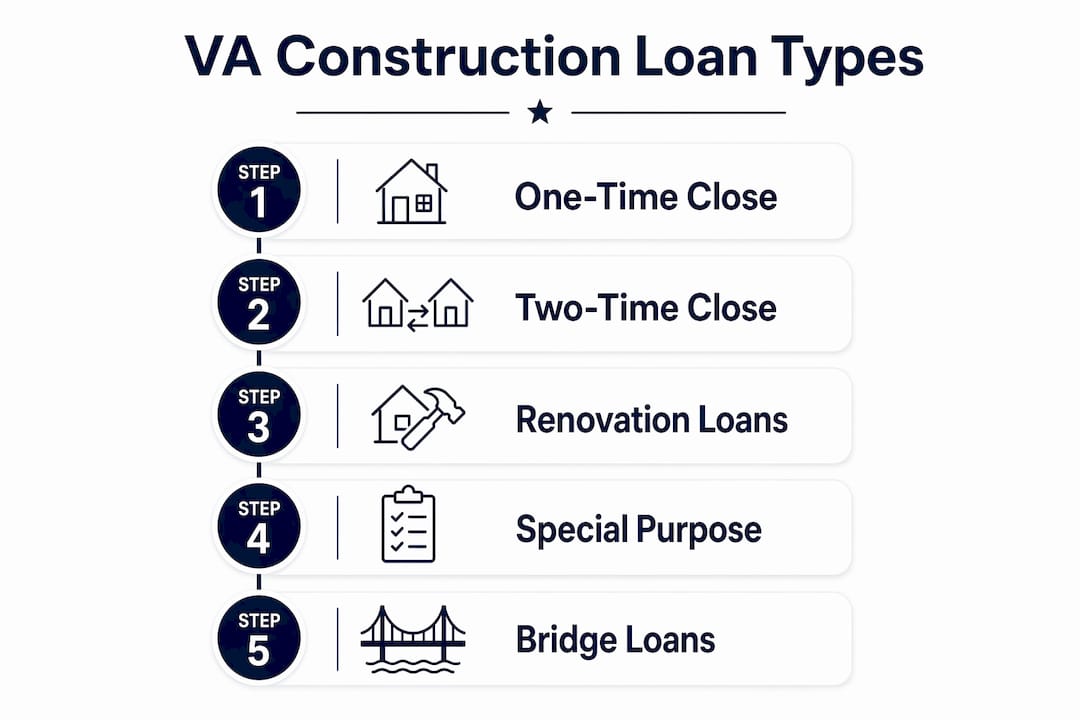
The alternative is a two-loan structure: a separate construction loan that converts to a permanent VA mortgage after the home is complete. Two closings mean two sets of closing costs, which is why most veterans pursuing new construction prefer the one-time close route.
What these loans typically finance:
- Land purchase (in most cases, when bundled with construction)
- Building costs including labor and materials
- Permits and fees required by local jurisdictions
- Contingency reserves for cost overruns
- Interest reserves to cover interest payments during the build phase
VA construction loans carry no down payment requirement and no private mortgage insurance, which can be especially beneficial in low home inventory areas. Loan limits follow the same county-level conforming limits that apply to standard VA purchase loans. Interest rates during construction are typically variable, converting to a fixed rate once the permanent loan kicks in, though terms vary by lender.
Eligibility and requirements for a VA construction loan
Qualifying for a VA construction loan means satisfying two sets of requirements: VA eligibility rules and the lender’s own underwriting standards.

VA eligibility starts with your service history. You need a Certificate of Eligibility (COE) to show the lender you qualify based on your active duty, reserve, or National Guard service. You can request a COE through the VA’s eBenefits portal, through your lender, or by mailing VA Form 26-1880.
Financial requirements are stricter than a standard VA purchase loan. Lenders typically want:
- Documented income with two years of employment or self-employment history
- Credit scores that meet the lender's minimum (often 620 or higher, though this varies)
- Sufficient cash reserves to cover several months of payments
- A complete accounting of assets, debts, and liabilities
Builder requirements are where many veterans get surprised. Your builder must hold a VA-registered builder ID and meet VA financial stability criteria. The VA maintains a database of approved builders at lgy.va.gov. If your preferred contractor is not registered, they can apply, but that adds time to your timeline.
The appraisal works differently here. A VA appraiser evaluates the home based on plans and specifications before a single nail is driven. The appraised value must support the loan amount before underwriting can proceed. After construction wraps, a final inspection confirms the home was built to spec, which triggers the VA guarantee and the loan’s conversion to permanent financing.
How to apply for a VA construction loan, step by step
- Confirm your VA eligibility and get your COE. Do this before you talk to a single lender. Knowing your entitlement amount shapes every conversation that follows.
- Find a lender with a real construction loan department. Not every VA-approved lender offers construction loans. Call directly and ask whether they have a dedicated construction lending team and an active one-time close product.
- Choose a VA-registered builder. Vet your contractor carefully. They need a VA builder ID, a track record of working within draw payment systems, and the financial stability to carry costs between draws.
- Submit your full loan application. This includes builder contracts, architectural plans and specs, income documentation, asset statements, and a complete credit package. Construction loans require more paperwork than purchase loans.
- Underwriting and appraisal. The lender's underwriter reviews your full file while the VA appraiser assesses value based on the submitted plans. Both must clear before you get a loan approval.
- Close the loan. With a one-time close, you sign once and lock both the construction financing and the permanent mortgage terms. This is the moment your builder can start drawing funds.
- Construction phase. The lender disburses funds in draw cycles, each triggered by a site inspection confirming completed milestones. Your builder gets paid in stages, not upfront.
- Final inspection and certificate of occupancy. Once construction is complete and the home passes final inspection, the loan converts to your permanent mortgage automatically.
Expert insights on the real challenges veterans face
The paperwork and eligibility hurdles are manageable. The harder problem, as anyone who has actually worked through a VA construction loan will tell you, is finding the right lender and the right builder at the same time.

Veterans frequently struggle to locate lenders with genuine construction loan infrastructure and builders willing to operate within VA draw payment schedules. Builders who work primarily with conventional financing sometimes balk at the inspection-triggered draw system because it slows their cash flow. That friction is real, and it kills deals.
On the lender side, watch for a specific red flag: a loan officer who says they can “look into” VA construction loans. Lenders without dedicated construction departments are often not equipped to close these loans, and you can lose months finding that out the hard way. Ask directly whether the lender has closed VA construction loans in the past 12 months and how many.
Pro Tip: Ask your lender for a list of builders they have worked with on previous VA construction loans. A lender with an active builder network has already solved the hardest part of the puzzle for you.
The no down payment and no PMI structure makes VA construction loans genuinely worth the extra effort, particularly in markets where existing home inventory is thin. Building new is sometimes the only realistic path to homeownership in those areas, and the VA benefit removes the biggest financial barrier.
Working with a mortgage broker who specializes in VA lending can compress your timeline significantly. Brokers with VA construction experience already know which lenders are actively closing these loans and which builders are registered and reliable. That shortcut alone can save you weeks.
Platinumcapitalfinancial can help you navigate VA construction lending in Florida
Veterans building homes in Florida face a specific challenge: a competitive market, limited inventory in many counties, and a short list of lenders who actually close VA construction loans. Platinumcapitalfinancial works as a mortgage broker focused on Florida home financing, which means we shop your loan across multiple VA-approved lenders rather than locking you into a single institution’s product.
For veterans pursuing new construction, that access matters. We can connect you with lenders who have active VA construction loan programs, help you understand your COE and entitlement, and use our builder loan calculator to model your costs before you commit to a builder contract. If you are also weighing a VA mortgage in Collier County, we handle that too.
Ready to find out which VA construction loan options fit your situation? Contact Platinumcapitalfinancial for a no-obligation consultation and get a clear picture of your financing path before you break ground.
Key Takeaways
VA construction loans are available through a small group of VA-approved private lenders, and finding one with a dedicated construction department is the single most important step a veteran can take.
Recommended
- VA Construction Loan Interest Rates 2026 Guide
- Top 6 VA Land Loans Providers 2026
- VA Construction Loan Rates and New Build Planning in Naples
- VA Loans vs Conventional Loans in Naples Florida 2026
Get a free instant rate quote
Take a first step towards your dream home

Free & non binding
No documents required
No impact on credit score
No hidden costs
.svg)
.svg)
.svg)
.svg)

.svg)
