
.svg)
Mortgage News
What Is Mortgage Lock? a Florida Buyer's Guide
If you’re buying a home in Florida and you’ve heard the term “mortgage lock” without fully understanding what it means, you’re not alone. A mortgage lock, also called a rate lock, is an agreement between you and your lender that freezes your interest rate for a set period while your loan is processed. Most buyers assume a locked rate is an iron-clad guarantee no matter what. It isn’t. Changes to your credit, employment, or appraisal can still cause your rate to shift even after you’ve locked. Knowing exactly how this works could save you thousands.
Table of Contents
- Key Takeaways
- What is mortgage lock and how it works
- Mortgage locks in Florida's real estate market
- Lock features: float-downs, extensions, and fees
- How to lock your mortgage rate effectively
- My take on navigating mortgage locks in Florida
- Work with a Florida mortgage expert who knows rate locks
- FAQ
Key Takeaways
What is mortgage lock and how it works
A mortgage lock is a formal commitment from your lender that your interest rate will not change between the day you lock and the day you close, as long as your loan application details stay the same. Standard locks run 30 to 60 days, which covers most conventional purchase timelines. For new construction or complex loans, extended locks up to 12 months are available, though they come with a higher price.
The mechanics are straightforward. Once you receive a purchase agreement and your lender gives you a loan estimate, you can ask to lock the quoted rate. The lender then documents that rate along with the lock expiration date and any associated conditions.
Here is what a standard mortgage lock protects you from and where its limits are:
- Rate increases: If market rates rise during your lock period, you still close at the lower locked rate.
- Market volatility: In unpredictable rate environments, a lock removes the anxiety of daily rate watching.
- Budget uncertainty: A locked rate lets you calculate your exact monthly payment and plan accordingly.
However, a mortgage lock is conditional, not absolute. Lenders lock a specific rate tied to your exact loan profile at that moment. If your credit score drops before closing, if the property appraises lower than expected, or if you change jobs during underwriting, your lender has the right to reprice or even void the lock. Think of it less as a guaranteed number and more as a rate tied to a snapshot of your financial picture. Keep that picture the same, and your rate holds.
Regarding cost, there is a common misunderstanding here worth addressing. Even a “free” lock often has a cost. Lenders frequently build lock fees into your origination charges or slightly elevate the interest rate itself rather than billing you separately. Always ask your lender to spell out how the lock cost is structured.
Pro Tip: Ask your lender for a written lock confirmation that specifies the rate, lock expiration date, and any conditions that could trigger repricing. A verbal agreement is not enough.
Mortgage locks in Florida’s real estate market
Florida’s housing market has specific characteristics that make understanding your mortgage lock period more consequential than in many other states. The state’s inventory moves fast in metro areas like Miami, Tampa, and Naples, which means closing timelines can shift due to inspection delays, title issues, or appraisal scheduling backlogs. Any of these can push you close to or past your lock expiration.

Florida also has a higher concentration of condo properties, and condos often require additional lender review for factors like HOA financial health and owner-occupancy ratios. These reviews take time. Lock periods of 15 to 90 days exist for a reason, and Florida buyers frequently find that 30-day locks leave little margin.
Here are common pitfalls Florida buyers and investors run into during the lock period:
- Appraisal delays: High demand and limited comparable sales in coastal markets can push appraisal turnaround times past 10 to 14 days.
- Condo documentation reviews: Additional HOA document review for condo purchases can add two to three weeks to processing.
- Investor loan complexity: Investment property loans often face stricter underwriting, which extends timelines and increases lock expiration risk.
- Insurance bottlenecks: Florida's property insurance market is notoriously tight. Securing adequate coverage before closing can take longer than expected and delay your closing date.
For owner-occupants buying a primary residence in a standard single-family transaction in Florida, a mortgage loans in Naples Florida broker familiar with local timelines can help you choose a lock length that matches the realistic pace of your deal. Investors buying rental properties or condos should default to at least a 45 to 60-day lock given these added complexities.
Lock features: float-downs, extensions, and fees
Once you understand the basics of a mortgage lock, the next level is knowing the features that can work in your favor and the fees that can catch you off guard.
Float-down options
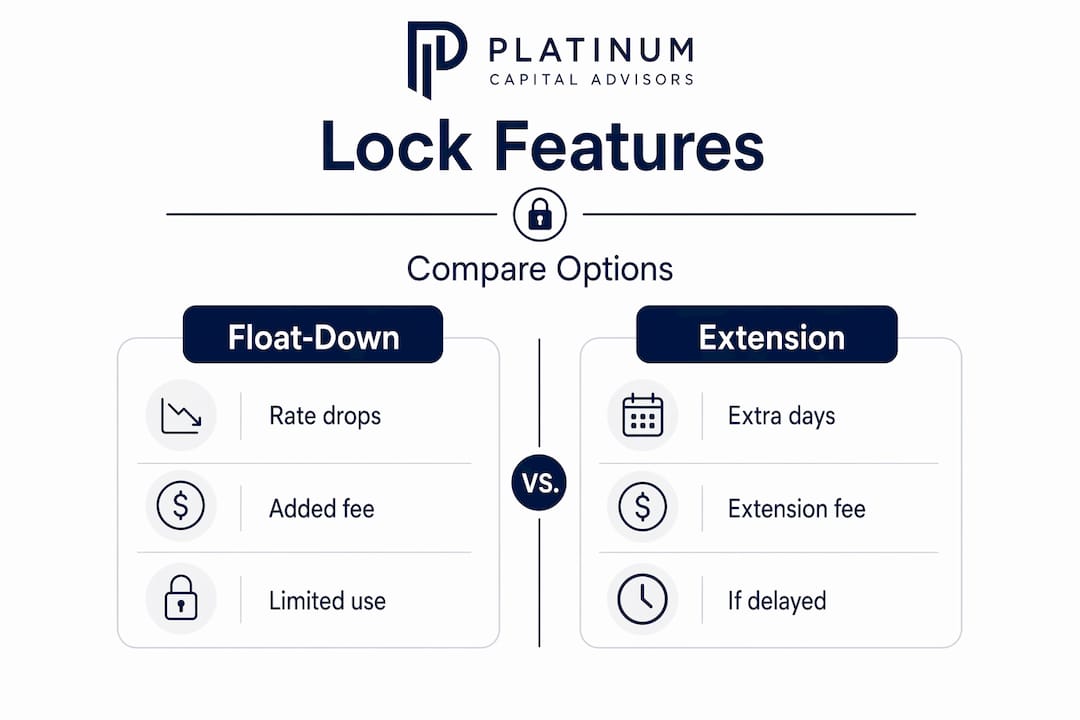
A float-down is an add-on feature that lets you capture a lower rate if market rates fall after you lock. Float-downs typically cost 0.125% to 0.50% of the loan amount and are activated only if rates drop by a defined threshold, usually 0.25% to 0.50%. On a $400,000 loan, a float-down fee might run $500 to $2,000. Whether that cost is worth it depends on where rates are trending when you lock.
Lock extensions
If your closing gets delayed, your lock may expire before you close. At that point you have two choices: pay for an extension or let the lock expire and re-lock at the current market rate. Requesting an extension before expiration gives you the best leverage. If the delay was caused by the lender’s own underwriting process, you may qualify for a free or reduced-cost extension.
Comparing your options
Pro Tip: If you’re in a rising rate environment, locking after offer acceptance is standard practice. But if rates are already elevated and trending upward, consider locking as early as your lender allows even before the full underwriting begins.
How to lock your mortgage rate effectively
Taking the right steps in the right order makes the difference between a smooth closing and a scramble to protect your rate. Here is a practical sequence:
- Get pre-approved before you make an offer. Pre-approval gives you a realistic rate range and establishes your loan profile, which is the financial snapshot your lock will be tied to.
- Ask about lock options during pre-approval. Do not wait until after you sign a contract to learn your lender's lock lengths, fees, and whether float-downs are available. Knowing all lock features upfront prevents costly surprises.
- Lock the rate once your purchase offer is accepted. This is the standard timing for most buyers. You have a confirmed property, a price, and a target closing date.
- Do not change your financial profile after locking. Avoid opening new credit accounts, making large purchases on credit, changing jobs, or moving large amounts of money between accounts. Any of these changes can trigger a re-pricing or void the lock entirely.
- Respond quickly to your lender's requests. Underwriting delays are often borrower-caused simply because documents were slow to arrive. Speed on your end keeps the loan moving and reduces the chance of your lock expiring.
- Monitor your lock expiration date. Put the date on your calendar. If you see closing might slip past it, contact your lender at least five to seven business days before it expires. Waiting until it has already expired leaves you with less negotiating room and fewer options.
- Request a written extension if needed. If lender underwriting is the reason for delay, proactively requesting an extension often results in little or no extra cost.
My take on navigating mortgage locks in Florida
I’ve worked with Florida buyers across all kinds of market conditions, and the single biggest mistake I see is treating a rate lock like a finished task instead of an active responsibility. You lock the rate, and then you stop paying attention. That is where things go wrong.
In my experience, the buyers who come to closing with the rate they expected are the ones who stayed in constant contact with their lender, responded to document requests the same day, and checked in on their lock expiration at least once a week. The ones who struggled were often surprised to find their rate had changed because a new credit card showed up on their report or because a delayed appraisal pushed them past their lock window.
Florida specifically adds layers. The insurance market, condo rules, and fast-moving inventory create more variables than most states. My honest advice: choose a lock period that is longer than you think you need, ask about float-down options if rates are uncertain, and work with a mortgage professional who knows Florida’s closing timelines from real experience. A lock is a tool. Like any tool, it only works when you use it correctly.
- Chuck Barnes
Work with a Florida mortgage expert who knows rate locks
Getting your mortgage lock strategy right starts with working with someone who knows Florida’s market, not just mortgages in general.
At Platinumcapitalfinancial, we work with Florida homebuyers and investors across Naples, Collier County, and beyond to structure loans that make sense for your timeline, risk tolerance, and long-term goals. We explain lock periods, float-down costs, and extension options in plain language before you commit to anything. Whether you’re buying your first home or expanding a rental portfolio, we help you secure the rate and terms that fit your situation. Visit our Florida mortgage loans page to explore your options or speak with our team about locking in a competitive rate today.
FAQ
What is a mortgage lock in simple terms?
A mortgage lock is a lender’s promise to hold your interest rate steady for a set period, typically 30 to 60 days, while your loan is processed and closed.
Can my locked rate still change?
Yes. A locked rate can be repriced or voided if your credit score drops, your income changes, the property appraises below the purchase price, or other key details of your loan application shift before closing.
When should I lock my mortgage rate?
Most buyers lock their rate after a purchase offer is accepted. In a rising rate environment, locking earlier, even before underwriting begins, can protect you from higher costs.
What is a float-down option on a mortgage lock?
A float-down lets you reduce your locked rate if market rates fall by a defined amount before closing. It typically costs 0.125% to 0.50% of the loan amount and is triggered only when rates drop past a set threshold.
How long should my mortgage lock period be in Florida?
Given Florida’s appraisal timelines, condo documentation requirements, and insurance complexities, most Florida buyers are better served by a 45 to 60-day lock rather than the standard 30-day option.
Recommended
Get a free instant rate quote
Take a first step towards your dream home

Free & non binding
No documents required
No impact on credit score
No hidden costs
.svg)
.svg)
.svg)
.svg)

.svg)
