
.svg)
Mortgage News
What Is Loan Origination? A Clear Guide for Borrowers
Loan origination is the complete process a lender uses to evaluate, approve, and fund a new loan after you submit an application. Every mortgage you’ve ever heard of started here. Before a single dollar changes hands, the lender runs you through a structured sequence of credit checks, document reviews, appraisals, and legal disclosures. Understanding how that sequence works puts you in a much stronger position to move through it quickly and cheaply.
Here’s what matters most to you as a borrower:
- Steps: The loan origination process moves from preapproval through formal application, processing, underwriting, and closing.
- Fees: Origination fees are typically about 0.5%–1% of the mortgage loan amount, and total closing costs usually run 2%–5% of the purchase price.
- Documents: A loan officer or processor will request pay stubs, tax returns, bank statements, and ID at multiple points.
- Timeline: Most mortgage originations take roughly 30–60 days, with many closing in 30–45 days when your paperwork is organized.
Table of Contents
- What does loan origination actually include?
- How does loan origination work, step by step?
- Who's involved and what does each person do?
- What fees will you pay, and what disclosures protect you?
- How long does loan origination take?
- What do underwriters actually look for, and how should you prepare?
- How origination differs across loan types
- Key Takeaways
- The part most borrowers underestimate
- Useful sources and regulators to bookmark
What does loan origination actually include?
Loan origination covers every administrative and credit-evaluation step from the moment you apply until the loan is funded and recorded. That includes the application itself, the appraisal, a title search, underwriting, and the final closing disclosures. Once the loan closes and you start making payments, you’ve crossed into loan servicing territory, which is a completely separate function.
The distinction matters because your lender may sell your loan to a servicer shortly after closing. That servicer collects your monthly payments, manages escrow, and handles payoff requests. They had nothing to do with origination. Knowing this prevents confusion when you get a letter saying your loan has been transferred to a new company three weeks after you closed.
Tasks that fall inside origination include: collecting and verifying your application data, ordering the appraisal and title search, running credit checks, issuing the required disclosures, completing underwriting, and coordinating the closing.
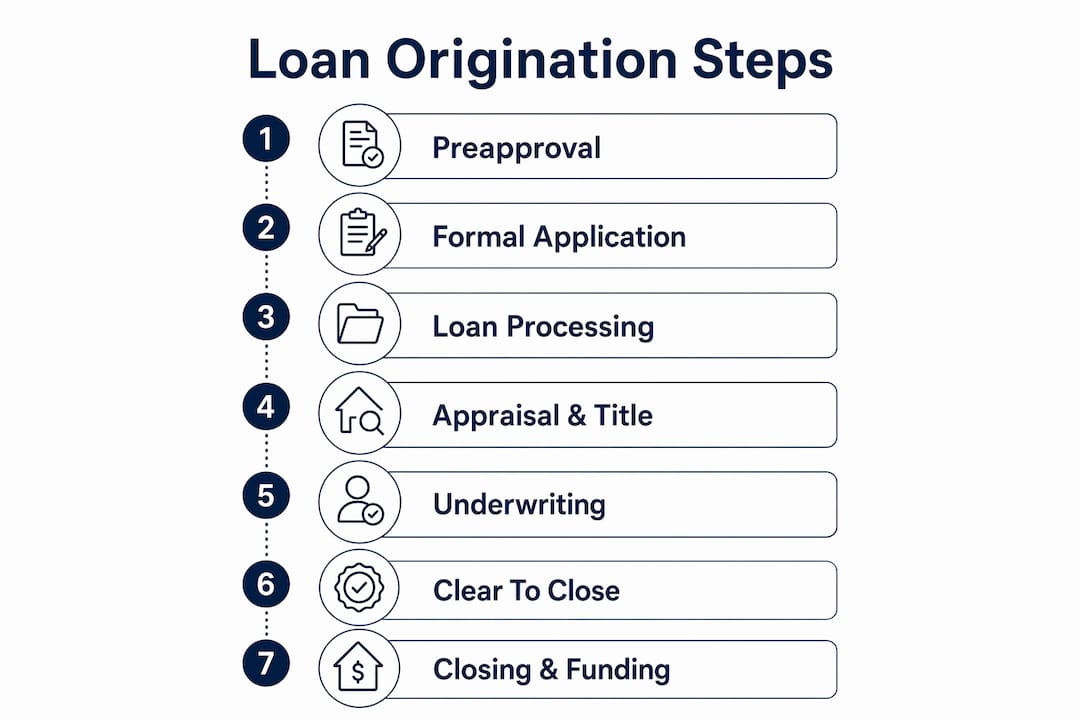
How does loan origination work, step by step?
The process follows a predictable order. Each stage has a clear borrower deliverable, and delays almost always trace back to one step where something stalled.
1. Preapproval
You submit basic financial information — income, assets, debts, credit — and the lender issues a conditional commitment for a loan amount. This is not a guarantee, but it tells sellers you’re a serious buyer. Bring two years of W-2s and recent pay stubs to this stage.
Pro Tip: Get preapproved before you start house hunting. Sellers in competitive Florida markets routinely reject offers that don’t include a preapproval letter.
2. Formal application
Once you’re under contract on a property, you complete the full Uniform Residential Loan Application (Form 1003). The lender collects detailed income, employment, and asset documentation here.
3. Loan processing
A loan processor organizes your file, orders third-party reports (appraisal, title search, flood certification), and verifies that every document is complete and consistent. This is the stage where missing pages or unsigned forms cause the most friction.

Pro Tip: Respond to document requests within 24 hours. A processor waiting on one bank statement can hold up the entire file.
4. Appraisal and title search
An independent appraiser values the property. A title company confirms the seller has clean ownership and no liens. Both reports feed directly into underwriting.
5. Underwriting
The underwriter makes the actual credit decision. They review everything the processor assembled and evaluate your risk profile against the lender’s guidelines. This is the most time-intensive phase, and it’s where conditional approvals are issued. Expect requests for additional documents — treat every one as urgent.
6. Clear to close
Once all conditions are satisfied, the underwriter issues a “clear to close.” The lender prepares the final Closing Disclosure, which must reach you at least three business days before closing.
7. Closing and funding
You sign the loan documents, pay closing costs, and the lender disburses funds. For a purchase, the title company coordinates the transfer of ownership simultaneously.
Who’s involved and what does each person do?
Knowing who to call — and why — saves a lot of frustration during origination.
Loan officer (or mortgage broker): Your primary contact. They explain loan products, lock your rate, and guide you through the application. A broker, unlike a direct lender’s loan officer, shops your file across multiple lenders to find the best terms. If you want to understand how a mortgage broker negotiates rates on your behalf, that’s worth reading before you commit to a lender.

Loan processor: The behind-the-scenes coordinator. They collect documents, order reports, and build the complete file for underwriting. You’ll hear from them frequently during processing.
Underwriter: The decision-maker. They don’t communicate with borrowers directly, but their conditions drive most of the back-and-forth during the middle stages of origination.
Appraiser: An independent third party who assesses the property’s market value. You pay for the appraisal, but you don’t choose the appraiser.
Closer / title officer: Manages the final signing appointment, coordinates fund disbursement, and records the deed. They’re your last contact before you get the keys.
Choosing between a broker and a direct lender comes down to a few practical factors: how many lenders you want access to, how much guidance you need, and whether you prefer a single point of contact or direct access to a lender’s internal team.
What fees will you pay, and what disclosures protect you?
Fees in loan origination fall into two broad categories: lender fees and third-party fees.
Total closing costs typically run 2%–5% of the purchase price.
The Loan Estimate and TRID protections
Under the CFPB’s TRID rule, lenders must provide a Loan Estimate within three business days of receiving your complete application. That document itemizes every fee, your estimated rate, and your projected monthly payment. Before closing, you’ll receive a Closing Disclosure at least three business days in advance — giving you time to compare it line-by-line against the Loan Estimate and flag any unexpected changes.
One thing many borrowers miss: some lenders advertise “no origination fee” but offset that with a higher interest rate or by rolling costs into the loan balance. Always compare APRs, not just the rate or the fee name. APR captures the full cost of borrowing in a single number.
How long does loan origination take?
For a standard purchase mortgage, plan on a timeline from application to closing that can vary widely. When documents are organized and the property appraises cleanly, loans may close more quickly.
The most common causes of delay:
- Incomplete documentation: Missing pages, unsigned forms, or inconsistent income figures are the single biggest source of delays.
- Appraisal issues: A low appraisal triggers renegotiation or a second appraisal, adding days or weeks.
- Title problems: Unresolved liens, ownership disputes, or errors in public records can halt closing entirely until resolved.
- Income verification: Self-employed borrowers, commission earners, or anyone with complex tax returns often face additional underwriting scrutiny.
- Underwriting conditions: Every condition the underwriter issues restarts a review cycle. Slow responses extend the timeline.
Digital verification tools and automated income and asset checks can shorten preapproval and processing, but they don’t eliminate underwriting. Organized paperwork still drives the pace.
What do underwriters actually look for, and how should you prepare?
Underwriters evaluate every application through the lens of the Four Cs:
- Capacity: Your debt-to-income (DTI) ratio. Most conventional loans require a DTI at or below 43–45%.
- Credit: Your credit score and payment history. A higher score unlocks better rates and more loan options.
- Capital: Your down payment, cash reserves, and assets. Reserves matter because they signal you can cover payments if income dips.
- Collateral: The appraised value of the property. If the home doesn't appraise at the purchase price, the lender won't fund the full amount.
Gather these documents before you apply:
- Last 30 days of pay stubs
- Two years of W-2s
- Two years of federal tax returns
- Two months of bank statements
- Government-issued ID and Social Security number
- Asset statements (investment accounts, retirement accounts)
- Gift letters or divorce decrees, if applicable
Pro Tip: Get Loan Estimates from at least two or three lenders before committing. Lenders often adjust origination fees to win your business — competing estimates are your primary negotiating tool. If a lender won’t budge on the fee, ask whether they’ll lower the rate instead, then run the APR comparison.
How origination differs across loan types
The core steps are the same, but the details shift depending on what you’re borrowing.
Purchase mortgage: The full origination sequence applies. Preapproval, appraisal, title search, and most closing costs are all present. The origination fee is typically charged as a percentage of the loan. For first-time homebuyers, the document list can feel long, but the process is predictable once you know what’s coming.
Refinance: There’s no property purchase, so the title transfer step drops out. Appraisals may be waived in some cases, particularly for rate-and-term refinances on well-seasoned loans. Closing costs still apply, and borrowers can often roll them into the new loan balance. The timeline is usually shorter than a purchase.
Small personal loan: The origination process is compressed. There’s no appraisal, no title search, and fewer third-party costs. Origination fees may be a flat dollar amount or a percentage of the loan, deducted upfront or rolled into the balance. Documentation requirements are lighter, and some lenders fund within days.
Key Takeaways
Loan origination is the structured, lender-driven process that takes you from application to funded loan, and understanding it lets you move faster, spend less, and avoid the surprises that catch most borrowers off guard.
The part most borrowers underestimate
Most of the stress borrowers feel during origination comes from not knowing what’s happening or why. The underwriter asks for a letter of explanation on a two-year-old bank deposit, and suddenly it feels like the deal is falling apart. It almost never is. That’s a routine condition, and a clear, prompt response resolves it in a day.
What actually derails loans is avoidable: switching jobs mid-process, opening a new credit card, making a large undocumented cash deposit, or going quiet when the processor sends a document request. The borrowers who close on time are the ones who treat every request as a same-day priority and keep their financial picture stable from application through funding.
Working with a broker who knows your local market adds a layer of protection here. Platinumcapitalfinancial’s team in Florida has guided buyers through origination across Collier County and the surrounding area, and the most consistent thing they see is that preparation beats everything else. If you’re buying or refinancing in Florida, the mortgage broker services Platinumcapitalfinancial offers include walking you through exactly what to expect at each stage before you ever sign an application.

Useful sources and regulators to bookmark
These are the primary sources worth keeping on hand as you move through origination:
- CFPB — Loan Estimate and TRID guidance: consumerfinance.gov — the official regulator page explaining origination fees, Loan Estimate timing, and your rights as a borrower.
- Bankrate — Origination fee explainer: Covers typical fee ranges, how to negotiate, and what to look for on your Loan Estimate.
- Investopedia — Origination fee definition: Useful for understanding how "no-fee" offers work and why APR is the right comparison metric.
- Redfin — Mortgage loan process guide: Practical walkthrough of the full origination sequence with document checklists.
- Experian — How to get a mortgage: Covers closing cost ranges and what lenders look for during underwriting.
- Platinumcapitalfinancial — Florida mortgage resources: platinumcapitalfinancial.loans — local guidance for Florida homebuyers, including loan options and the origination process explained for the Florida market.
Keep your Loan Estimate and Closing Disclosure together after closing. They’re your record of what you were quoted versus what you paid, and you’ll want them if any fee discrepancy surfaces later.
This article is general information, not legal or financial advice. Confirm current rates, fees, and program eligibility with a licensed mortgage professional for your specific situation.
Recommended
- What is mortgage origination? Florida homebuyer's guide
- The Role of a Loan Officer in Home Financing
- What Is Lender Credit? A Clear Guide for Homebuyers
- What Is the Home Loan Process: A 2026 Guide
Get a free instant rate quote
Take a first step towards your dream home

Free & non binding
No documents required
No impact on credit score
No hidden costs
.svg)
.svg)
.svg)
.svg)

.svg)
