
.svg)
Mortgage News
What Is a Balloon Mortgage? Risks, Benefits, and How It Works
A balloon mortgage is a home loan with lower monthly payments for a set term, followed by one large lump-sum payment at the end that covers the remaining balance. According to the Consumer Financial Protection Bureau, that final payment is generally more than twice the loan’s average monthly payment. Under federal regulation, 24 C.F.R. § 81.2 defines a balloon mortgage as one where the final payment is at least 5% more than the periodic payments, due before the loan would fully amortize.
Key features at a glance:
- Loan terms typically run several years, while monthly payments are calculated on a longer amortization schedule
- Monthly payments stay low because they do not fully pay off the loan during the term
- The balloon payment arrives at maturity and can equal a large portion of the original loan amount
- Borrowers must either pay the balloon in full, refinance, or sell the property before the due date
Table of Contents
- How does a balloon mortgage work?
- Advantages and disadvantages of balloon mortgages
- Who uses balloon mortgages, and what does US law say?
- What experts say about refinancing risk and borrower suitability
- How balloon mortgages compare to fixed-rate and adjustable-rate loans
- Real repayment scenarios: what happens at balloon maturity
- How interest rates affect your balloon mortgage
- Strategies for managing balloon payment risk
- Platinumcapitalfinancial can help you find the right loan structure
- Key Takeaways
How does a balloon mortgage work?
Your monthly payment is calculated as if you had a long-term loan, but the loan itself matures in a shorter period. Zillow explains that borrowers pay monthly as though amortizing over a standard term, then owe the full remaining balance in one shot at the end of that shorter term.
Example: On a $300,000 loan at 6% interest structured as a 7-year balloon with 30-year amortization, your monthly payment would be roughly $1,799. After 7 years of payments, you would still owe approximately $278,000 as the balloon payment.
Common exit strategies before the balloon comes due:
- Refinance into a new conventional or adjustable-rate loan
- Sell the property and use the proceeds to pay off the balance
- Pay the lump sum from savings or other assets
The refinancing path is the most common, but it is not guaranteed. If your credit score drops or property values fall, a lender may decline your refinance application right when you need it most.
Advantages and disadvantages of balloon mortgages
Advantages
- Lower monthly payments free up cash flow during the loan term
- Potentially lower interest rates than a comparable fixed-rate loan
- Useful for borrowers who plan to sell or refinance before the balloon arrives
- Balloon loans give borrowers flexibility when they have a clear short-term exit strategy
Disadvantages
- The balloon payment can be a shock if you have not planned ahead
- Foreclosure risk rises if you cannot pay or refinance at maturity
- Property value declines can trap you with no viable exit
- Private balloon loans often carry higher interest rates and fewer consumer protections
The core trade-off is simple: you get lower payments now in exchange for a high-stakes obligation later. That works well for disciplined borrowers with a concrete plan, and poorly for everyone else.
Who uses balloon mortgages, and what does US law say?
Common borrower profiles:
- Commercial real estate investors who expect to sell or refinance within 5–10 years
- Homeowners in transitional situations (relocation, short-term ownership)
- Sellers offering private financing to buyers who cannot qualify for conventional loans
Commercial balloon loans are standard practice in real estate because they let lenders reassess risk and collateral value periodically. Residential balloon mortgages are a different story.
This means most mainstream residential lenders cannot offer balloon loans to typical homebuyers. Residential balloon mortgages today mostly appear in private, seller-financed transactions outside the Qualified Mortgage framework.
Private residential balloon loans fall outside standard consumer protections and typically carry higher interest rates. If you encounter one, read every term carefully.
What experts say about refinancing risk and borrower suitability
The biggest danger with a balloon loan is not the payment itself. It is the assumption that refinancing will be available when you need it.

Proactive refinancing planning should start at least 18 months before the balloon due date. Lenders tighten underwriting standards at renewal, scrutinizing loan-to-value ratios and debt-service coverage more strictly than at origination. A borrower who qualified easily five years ago may not qualify today if their income changed or the property lost value.
Expert recommendations:
- Start the refinancing process no later than 18 months before maturity
- Maintain strong credit throughout the loan term
- Monitor your property's market value annually
- Avoid balloon loans if you plan to stay in the home long-term without a clear payoff plan
Pro Tip: Build a dedicated reserve fund during the loan term. Even if you plan to refinance, having 6–12 months of balloon payment reserves gives you negotiating leverage and a safety net if the refinance falls through.
Balloon loans best serve borrowers with a clear exit strategy, not those hoping market conditions will work out in their favor.
How balloon mortgages compare to fixed-rate and adjustable-rate loans
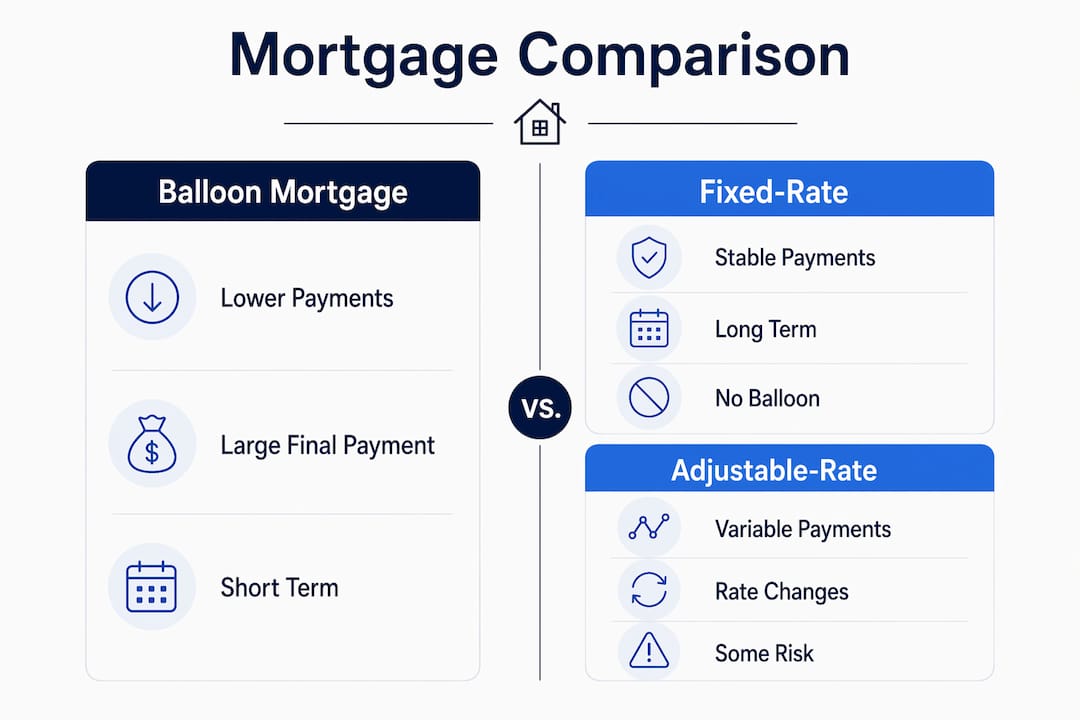
A fixed-rate mortgage eliminates the balloon risk entirely. An adjustable-rate mortgage shares some of the balloon’s short-term payment advantages without the lump-sum obligation at maturity.
Real repayment scenarios: what happens at balloon maturity
Scenario 1: Successful refinance. A commercial investor takes a 7-year balloon on a $500,000 property. At year 5, they begin the refinancing process, qualify for a new 20-year loan, and pay off the balloon with no disruption.
Scenario 2: Forced sale. A homeowner takes a 5-year balloon expecting to sell before maturity. The market softens. They sell at a slight loss but cover the balloon and avoid foreclosure.
Scenario 3: Default. A borrower cannot refinance because their credit score dropped and the property lost value. They cannot pay the balloon. The lender initiates foreclosure. You can use a payment scenario calculator to model your own numbers before committing to any balloon structure.
How interest rates affect your balloon mortgage
Interest rates shape a balloon mortgage in two ways: the initial rate during the loan term, and the rate environment you face when refinancing.
A low-rate environment at origination makes the balloon attractive. Monthly payments are small, and refinancing looks easy. Rising rates flip that picture. When your balloon comes due in a higher-rate environment, your refinance payment will be larger than your original payment, and some borrowers find they no longer qualify under tighter debt-to-income limits. The Federal Reserve’s Regulation Z, which governs repayment ability requirements for higher-priced balloon loans, requires lenders to assess whether borrowers can realistically refinance, not just make monthly payments.
Strategies for managing balloon payment risk
Platinumcapitalfinancial can help you find the right loan structure
Balloon mortgages are not the right fit for most Florida homebuyers, and knowing that before you sign saves you from a very expensive surprise. Platinumcapitalfinancial works with buyers across Florida to match them with loan structures that fit their actual timeline and risk tolerance, whether that is a conventional fixed-rate loan, an ARM, or a specialized product for a specific situation.
If you are weighing a balloon loan against other options, or you need to refinance out of one before maturity, Platinumcapitalfinancial’s team of Florida mortgage brokers can walk you through the numbers with no pressure and no guesswork. Reach out today to get a clear picture of what your payments and obligations would actually look like.
Key Takeaways
A balloon mortgage offers lower monthly payments in exchange for a large lump-sum obligation at maturity, making it suitable only for borrowers with a concrete, well-funded exit strategy.
Recommended
- Mortgage term explained: A clear guide for Florida buyers
- Mortgage Risk Naples Florida ARM Loan Guide
- What Is a Hybrid Mortgage? Your 2026 Guide
- Bridge Loan Calculator for Short Term Property Financing
Get a free instant rate quote
Take a first step towards your dream home

Free & non binding
No documents required
No impact on credit score
No hidden costs
.svg)
.svg)
.svg)
.svg)

.svg)
