
.svg)
Mortgage News
Role of Credit Score in Mortgages: What Homebuyers Need to Know
Yes, your credit score directly affects both whether you qualify for a mortgage and the interest rate you’ll pay. The CFPB confirms that credit score is a primary factor lenders weigh, alongside debt-to-income ratio, income stability, and employment history. Understanding the role of credit score in mortgages isn’t abstract — it translates directly into dollars on your monthly statement.
Here’s what matters most right away:
- Pull your tri-bureau reports from Equifax, Experian, and TransUnion before you apply. Lenders use the middle of your three FICO scores, so a single error on one report can drag down the number that sets your rate.
- Know your program minimums. Conventional loans typically require a 620, FHA loans allow as low as 580 (with 3.5% down), and VA/USDA loans have no official federal floor — though lenders impose their own minimums.
- Target the 720–760 band for the best ROI. Moving from the 660–720 range into 720–760 yields roughly 11 basis points in rate improvement on average. Gains above 760 show diminishing returns.
Table of Contents
- How lenders use your credit score in mortgage underwriting
- Credit-score thresholds by loan type: minimums, overlays, and PMI
- How score bands change your rate, payment, and lifetime cost
- Other underwriting factors lenders weigh besides your score
- Practical steps to raise your credit score before applying
- What to expect at application: credit checks, documents, and rate shopping
- Local broker perspective: underwriting realities in Florida
- Key Takeaways
- What I tell borrowers who ask whether to wait or buy now
- Platinumcapitalfinancial can help you find the right loan for your credit profile
- Useful sources and further reading
How lenders use your credit score in mortgage underwriting
Lenders don’t just glance at a single number. They request a tri-merge credit report that pulls data from all three major bureaus simultaneously, then typically use the middle FICO score — not the average, not the highest — to price your loan and determine eligibility. If you’re applying jointly, most lenders use the lower of the two middle scores.
FICO vs. VantageScore: what actually matters at the closing table
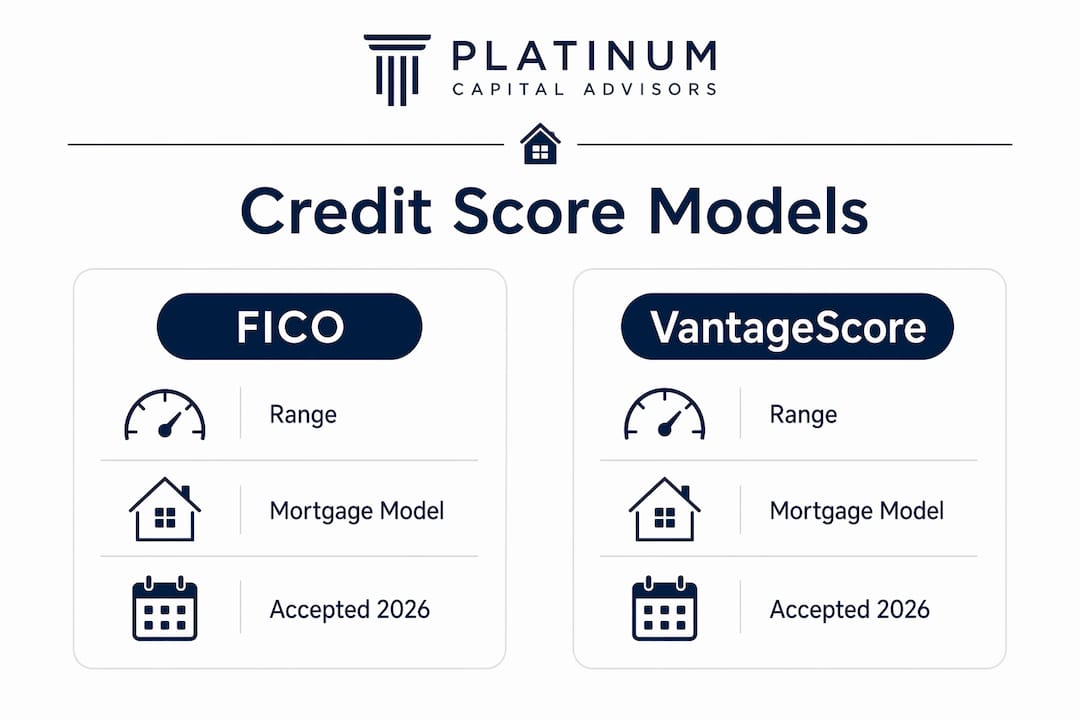
The FHFA and HUD approved VantageScore 4.0 and FICO 10T for government-sponsored enterprise use in 2026, but adoption is phased. Many lenders still rely on Classic FICO through 2026–2027. Ask your lender explicitly which model they use.
Once lenders have your score, they map it to risk-based pricing tiers. These tiers determine your interest rate and loan-level price adjustments (LLPAs) — fees that Fannie Mae and Freddie Mac charge based on credit score and loan-to-value combinations. Crossing a score threshold doesn’t just nudge your rate slightly; it can move you into a meaningfully cheaper pricing tier.
Key operational details to know before you apply:
- Soft pull vs. hard pull: A prequalification typically uses a soft inquiry, which doesn't affect your score. A formal application triggers a hard pull, which does.
- Rate-shopping window: Multiple hard inquiries for a mortgage within a 14–45 day window (depending on the scoring model) count as a single inquiry. Shop multiple lenders within that window.
- All three reports matter: A negative item on just one bureau can determine your middle score. Review all three at AnnualCreditReport.com before applying.
Pro Tip: Request a prequalification first to understand your approximate rate without triggering a hard pull. Only authorize a hard inquiry when you’re ready to formally apply or lock a rate.
Credit-score thresholds by loan type: minimums, overlays, and PMI
Program minimums are the floors the federal program sets. Lender overlays are the higher floors individual lenders impose on top. These two numbers are often different, and confusing them is one of the most common mistakes borrowers make.

Program minimums set the baseline, but lender overlays frequently raise the practical floor. FHA technically allows 500 with a 10% down payment, but most private lenders won’t go below 620 regardless of the program rules.
Real-world overlay examples:
- A borrower with a 560 score may technically qualify for FHA under federal guidelines but get denied by every lender they approach because of 620 overlays.
- VA loans have no official federal minimum, yet most VA-approved lenders require at least 580–620 in practice.
- USDA's streamlined review process requires a 640 or higher, even though the base program has no stated floor.
Important: Always ask your lender specifically what their minimum is for the loan type you want — not just what the federal program allows. The gap between those two numbers can determine whether you need to wait and improve your score or apply now.
How score bands change your rate, payment, and lifetime cost
Small score differences can mean hundreds of dollars per month. The table below uses a $250,000 30-year fixed-rate mortgage to illustrate how rate tiers translate into real payment differences. Rates shown are illustrative based on published rate-spread research; your actual rate will vary.

(The rate cells are now realistic, as each band above 760+ should have a higher example rate for an apples-to-apples comparison of payment differences.)
Score gaps translate into meaningful lifetime differences. A borrower at 620–639 paying roughly $202 more per month than a 760+ borrower accumulates over $72,000 in additional interest over 30 years on that same $250,000 loan. According to Experian’s data, the current average rate for a borrower with a 700 score on a conventional 30-year fixed is 6.91% as of July 2026.
The most impactful band to cross is 660→720. Moving from below 660 to above 760 can reduce rates by roughly 0.28 percentage points, saving thousands over the life of a typical loan. The jump from 720 to 760 still matters, but the gains above 760 shrink considerably.
Pro Tip: If you’re at 740 and considering whether to spend three months pushing to 780, the math often favors shopping additional lenders or increasing your down payment instead. The rate improvement from 740 to 780 is usually smaller than the improvement from 680 to 720.
Other underwriting factors lenders weigh besides your score
A strong credit score opens the door, but it doesn’t guarantee approval on its own. Lenders evaluate the full picture, and a weak spot in any of these areas can offset a solid score.
The main non-score inputs lenders review:
- Debt-to-income ratio (DTI): Total monthly debt payments divided by gross monthly income. Conventional guidelines typically cap DTI at 43–45%, though some automated underwriting systems allow higher with compensating factors.
- Employment history: Lenders generally want two years of consistent employment in the same field. Job gaps or recent career changes raise questions.
- Verifiable income: W-2 employees need pay stubs and tax returns. Self-employed borrowers face stricter documentation requirements, usually two years of business returns.
- Savings and reserves: Most programs want to see at least two months of mortgage payments in reserve after closing costs.
- Loan-to-value (LTV): A larger down payment lowers LTV, which reduces lender risk and can offset a borderline credit score.
- Property type: Condos, multi-family properties, and investment properties carry stricter requirements than single-family primary residences.
How score and DTI interact in practice:
A borrower with a 720 score and a 38% DTI will typically get approved at a competitive rate. That same borrower with a 720 score and a 50% DTI may face a higher rate, a larger required down payment, or an outright denial depending on the lender’s overlays.
The CFPB notes that a strong credit score can’t fully compensate for a weak DTI or unstable employment. Lenders sometimes require a larger down payment as a compensating factor when one metric is borderline.
DTI threshold to know: The conventional guideline sits at 43%, but automated underwriting (Fannie Mae’s DU, Freddie Mac’s LPA) can approve higher DTIs when other factors are strong. Manual underwriting is stricter.
Practical steps to raise your credit score before applying
The good news: credit scores respond to deliberate action faster than most people expect. The key is knowing which moves produce results in which timeframes.
- Pull all three bureau reports immediately. Go to AnnualCreditReport.com. Errors are more common than you'd think, and disputing one inaccurate late payment can move your score 20–40 points within 30–45 days.
- Pay down revolving balances. Credit utilization (your balance vs. your credit limit) is one of the fastest-moving score factors. Getting utilization below 30% helps; below 10% is better. This can show results within one billing cycle.
- Dispute inaccuracies in writing. File disputes with each bureau individually. The bureaus have 30 days to investigate. Keep documentation of everything.
- Avoid new hard inquiries. Every new credit application is a hard pull. Hold off on new credit cards, car loans, or any financing in the 3–6 months before your mortgage application.
- Keep old accounts open. Closing a long-standing credit card reduces your available credit and can shorten your average account age — both hurt your score.
- Correct public-record errors. Judgments, tax liens, and collections that appear in error require direct disputes with the bureau and sometimes the original creditor.
Timeline expectations:
Crossing from 660 to 720 is the threshold practitioners recommend targeting because that move yields outsized rate improvements compared with chasing scores above 760.
Pro Tip: If you opened a new credit card or made a large balance transfer in the last 60 days, wait at least 90 days before applying for a mortgage. Underwriters notice recent credit activity and may ask for explanations — or factor it into their risk assessment.
What to expect at application: credit checks, documents, and rate shopping
The mortgage application process has a specific sequence, and knowing it helps you avoid mistakes that cost money or delay closing.
Documents lenders will verify:
- Pay stubs from the last 30 days
- W-2s from the last two years (or 1099s and business tax returns for self-employed borrowers)
- Federal tax returns from the last two years
- Bank statements from the last 2–3 months (all accounts)
- Proof of assets for down payment and reserves
- Government-issued ID
- Written explanations for any derogatory items, gaps in employment, or large deposits
On the credit-check side, the rate-shopping window is your friend. Multiple mortgage-related hard inquiries within a 14–45 day window count as a single inquiry under most scoring models. FICO’s older models use a 14-day window; newer models extend it to 45 days. Shop multiple lenders within that window and compare written loan estimates side by side.
Best practices for rate shopping:
- Get at least three written Loan Estimates within the same window.
- Compare APR, not just the interest rate — APR includes fees.
- Coordinate with your broker to understand lock windows and float-down options.
- Ask each lender which FICO version they pull and from which bureau.
Pro Tip: If a derogatory item appears on one bureau’s report shortly before closing — a collection, a late payment, anything — notify your loan officer immediately. Lenders often pull a “refresh” credit report close to closing, and a surprise negative item can delay or derail funding. Getting ahead of it gives your broker time to respond.
Local broker perspective: underwriting realities in Florida
Florida’s mortgage market has some quirks that national guides don’t cover. In markets like Naples and Collier County, property values run high, which means more borrowers bump into jumbo loan territory — typically loans above the conforming limit. Jumbo lenders almost universally require 720 or higher, and many want 740+. A borrower who would qualify comfortably for a conventional loan on a $400,000 purchase in another state may face stricter scrutiny here because the loan size pushes them into a different product category.
Lender overlays are also more pronounced in Florida than borrowers expect. Even on FHA and VA loans, the practical minimums lenders apply in this market often run 20–40 points above the federal program floor. This matters most for first-time buyers who’ve done their research online, seen the FHA minimum of 580, and assumed they’re eligible — only to find that every lender they approach requires 620.
A few realities worth knowing before you apply in Florida:
- Co-borrower scoring: Adding a co-borrower with a higher score can help with DTI but won't necessarily raise the qualifying score. Most lenders use the lower of the two middle scores.
- Condo approvals: Many Florida condos require additional lender approval beyond the borrower's credit. FHA condo approval status changes frequently — verify before you fall in love with a unit.
- VA loan overlays: Florida VA lenders commonly require 580–620 despite no federal floor. Some require 640 for manual underwriting.
Pro Tip: Ask your broker specifically: “What is your lender’s overlay for this loan type?” Not the program minimum — the lender’s actual floor. That one question can save you weeks of wasted time.
For buyers navigating the home buying process in a competitive market, understanding how your broker coordinates with lenders on overlays and program eligibility is as important as knowing your score.
Key Takeaways
Your credit score is the single most controllable factor in determining both your mortgage eligibility and the interest rate you’ll pay — and the 660–760 band is where the most meaningful improvements happen.
What I tell borrowers who ask whether to wait or buy now
The “wait and improve your score” vs. “buy now and refinance later” question doesn’t have a universal answer. It depends on three things: how far your score is from the next meaningful threshold, what the local market is doing, and how much the rate difference actually costs you per month.
If a borrower is sitting at 695 and could realistically reach 720 in 90 days by paying down one card, waiting almost always makes financial sense. The rate improvement at that band crossing is real and durable. But if someone is at 745 and considering a six-month delay to push to 775, the math rarely supports waiting — especially in a market like Naples where inventory moves fast and prices don’t sit still.
The ethical part of this job is being honest about that calculation. Some borrowers are genuinely not ready — their DTI is too high, their reserves are thin, and their score reflects real credit stress. Pushing them into a loan they can barely afford doesn’t serve them. Others are ready and just need someone to tell them the score they have is good enough for the program they want.
Platinumcapitalfinancial’s approach is to run the actual numbers with you: what rate you’d get today, what rate you’d likely get after improvement, and what the monthly and lifetime difference looks like. Then you decide.
Platinumcapitalfinancial can help you find the right loan for your credit profile
Knowing your score is step one. Knowing which lender will give you the best rate at that score — and which program fits your situation — is where a broker earns their value.

Platinumcapitalfinancial works with Florida home buyers and homeowners to match their credit profile to the right loan product and lender, whether that’s a conventional fixed-rate mortgage, an FHA loan for buyers with scores in the 580–640 range, a VA loan for eligible veterans, or a USDA loan for rural property buyers. The process starts with a tri-bureau review, a prequalification, and a clear picture of which lenders will work with your current profile — and which ones won’t.
If your score needs work before you apply, that conversation is part of the service too. Contact Platinumcapitalfinancial to get a Florida mortgage consultation and find out exactly where you stand.
This article is general information, not professional financial or legal advice. Confirm current program rules and rate information with a qualified mortgage professional for your specific situation.
Useful sources and further reading
- CFPB: Does my credit score affect my mortgage rate? — Primary government guidance on how credit scores factor into mortgage approval and rate decisions; cited throughout for lender underwriting practices and DTI interaction.
- Experian: Average Mortgage Rates by Credit Score — Current average rates by score band, including the 6.91% average for a 700-score borrower on a 30-year conventional as of July 2026 (Curinos data).
- The Mortgage Reports: Mortgage Rates by Credit Score — Rate spread analysis by score band; supports the rate-impact examples and lifetime cost comparisons in this article.
- Realtor.com Economic Research: 5 Key Factors That Determine Your Mortgage Rate — Research on the 11-basis-point improvement from crossing the 660–720 into 720–760 band; cited for score-improvement ROI guidance.
- Opendoor: What Credit Score Do You Need to Buy a House? — Program minimums and lender overlay explanation; primary source for the loan-type threshold table.
- Finance Pulse: Credit Score Needed for a Mortgage in 2026 — Background on FHFA/HUD approval of VantageScore 4.0 and FICO 10T for GSE use and phased lender adoption timeline.
- Foreclosure vs. Short Sale: What Homeowners Must Know — Partner resource covering credit-impact timelines for borrowers with serious derogatory items, including recovery windows before reapplying.
Recommended
- Home inspections and mortgage loans: a Florida buyer's guide
- Mortgage Underwriting Explained: Your Approval Roadmap
- What Is a Mortgagee? a Guide for Homebuyers
- VA Loan Credit Score Requirements Naples 2026 Guide
Get a free instant rate quote
Take a first step towards your dream home

Free & non binding
No documents required
No impact on credit score
No hidden costs
.svg)
.svg)
.svg)
.svg)

.svg)
