
.svg)
Mortgage News
How to Improve Mortgage Eligibility: Steps for Homebuyers
Pay down revolving credit card balances, lower your debt-to-income ratio, and document steady income — those three moves do more to raise your mortgage approval odds than almost anything else you can do before applying.
Here is a quick checklist to start this week:
- Pull your free credit reports from Equifax, Experian, and TransUnion at AnnualCreditReport.com and dispute any errors
- Pay down revolving balances to reduce your credit utilization ratio to a lower level commonly recommended by lenders.
- Make every minimum payment on time — no exceptions
- Calculate your debt-to-income (DTI) ratio and identify debts to eliminate
- Stop applying for new credit cards, auto loans, or personal loans
- Move your down payment savings into a dedicated account and document every deposit
- Gather two years of W-2s, recent pay stubs, and bank statements
- Contact a mortgage broker like Platinum Capital Advisors to review your profile before you apply
Timeline reality check: Reducing utilization can lift your score in 30–60 days. Building a meaningful credit history or saving a full down payment typically takes 6–24 months. Plan accordingly.
A FICO score of at least 620 is the common floor for conventional loans, with 670 or higher putting you in a noticeably better position on rate and approval. FHA, VA, and USDA programs can open doors if you fall short of that conventional threshold.
Table of Contents
- How do mortgage lenders decide if you qualify?
- How to improve each factor before you apply
- Which loan programs can help you qualify sooner?
- How long does it realistically take to improve eligibility?
- What documents do lenders need, and how does pre-approval work?
- How a mortgage broker can speed up your approval
- Key Takeaways
- The fix most buyers overlook
- Ready to get a clearer picture of your eligibility?
- Useful sources
How do mortgage lenders decide if you qualify?
Lenders are not guessing when they review your application. They work through a defined set of buckets, and every piece of documentation you submit maps to one of them.

Credit score and history. Your FICO score is the first filter. A minimum FICO score is often required for conventional loans; higher scores typically lead to better pricing and smoother underwriting. Beyond the number, lenders look at your payment history, how long your accounts have been open, and whether you have recent delinquencies or collections. HUD’s mortgage credit analysis framework describes this as one of the four C’s of credit: credit history, capacity, cash assets, and collateral.
Debt-to-income ratio. DTI is the percentage of your gross monthly income that goes toward debt payments. Lenders track two versions. The front-end ratio covers only your proposed housing payment (principal, interest, taxes, insurance). The back-end ratio adds all monthly debt obligations. Most lenders want your back-end DTI under 43%, and many prefer 36% or lower. The lower your DTI, the better your rate and the easier the approval.
Income stability and verifiability. A lender needs to see that your income is real, consistent, and likely to continue. W-2 employees have the easiest path. Self-employed borrowers, freelancers, and those with bonus or overtime income face more scrutiny because secondary income types typically require two years of tax return evidence before a lender will count them.
Assets and reserves. Your down payment is only part of the picture. Lenders also want to see reserves — money left in your accounts after closing. Two months of mortgage payments in reserve is a common benchmark, though requirements vary by loan type and lender.
Property type and occupancy. A primary residence gets more favorable treatment than an investment property or second home. Condos, manufactured homes, and multi-unit properties each carry their own underwriting rules.
The documentation lenders request for each bucket:
- Credit: authorization to pull your credit report
- Income: pay stubs (most recent 30 days), W-2s (two years), tax returns (two years for self-employed)
- Employment: Verification of Employment (VOE) or telephone confirmation
- Assets: bank statements (two to three months), Verification of Deposit (VOD)
- Property: appraisal, title search, homeowners insurance binder
How to improve each factor before you apply
Eligibility improvements split into two categories: quick wins you can execute in weeks, and longer projects that take 3–12 months. Know which is which before you build your timeline.
Credit score: the fastest lever you have
Your credit utilization ratio — how much of your available revolving credit you are using — updates every billing cycle. Paying down balances can move your score in 30–60 days, which makes it the fastest single action most borrowers can take.
Step-by-step credit improvement:
- Pull all three reports (Equifax, Experian, TransUnion) and flag every error
- File disputes directly with each bureau for inaccurate accounts, wrong balances, or outdated negative items
- Pay every bill on time from this point forward — payment history is the largest component of your FICO score
- Target utilization below 30% on each card, not just in aggregate
- Avoid opening any new accounts for at least 6–12 months before applying
- Keep old accounts open even if you are not using them — length of credit history matters
Pro Tip: Attack the card with the highest utilization rate first, not necessarily the highest balance. A card at 85% utilization hurts your score more than a card with a larger balance at 30% utilization. Bring the worst offender below 30% before spreading payments across other cards.
Hard inquiries from new credit applications stay on your report for two years and can lower your score by a few points each. More importantly, a new account lowers your average account age and signals to underwriters that your financial picture recently changed. Avoid new credit for 6–12 months before you apply.
DTI reduction: a worked example
Say your gross monthly income is $6,000. Your current monthly debt payments are:
Your current back-end DTI: $800 ÷ $6,000 = 13.3% before housing. Add a proposed mortgage payment of $1,800 and your back-end DTI becomes $2,600 ÷ $6,000 = 43.3% — right at the common ceiling.
Pay off the car loan and your back-end DTI drops to $2,150 ÷ $6,000 = 35.8%, well inside the preferred 36% threshold. That one move can be the difference between a marginal approval and a clean one.
Tactics to reduce DTI:
- Pay off or pay down revolving balances and installment loans before applying
- Avoid taking on any new monthly obligations (car, furniture financing, personal loans)
- If you have a side income or rental income with a two-year history, document it — it raises the denominator
- Ask your employer about a raise or promotion letter if one is pending
Income and employment: what lenders need to see
Lenders verify two years of employment history. Changing jobs right before applying is not automatically disqualifying, but it adds complexity — especially if you move from salaried to self-employed or commission-based pay. If a job change is coming, try to close your mortgage first or wait until you have at least 12 months of history in the new role.

Overtime, bonuses, and side-gig income can be counted, but only with a two-year paper trail. If you started a side business last year, that income likely will not help you this application cycle.
Assets and down payment: document everything
Lenders need to verify where your down payment came from. Large, undocumented deposits raise red flags during underwriting. Keep your down payment funds in one dedicated account for at least 60–90 days before applying, and save every transfer record.
Gift funds from family members are allowed on many loan types, but they require a signed gift letter stating the money does not need to be repaid. Down-payment assistance programs — offered through state housing finance agencies and local governments — can supplement your savings. Check your state’s housing finance agency for current programs.
Which loan programs can help you qualify sooner?
Not every borrower needs to hit conventional loan standards before buying. Government-backed loan programs exist specifically to lower the bar on down payment and credit requirements.
Program comparison
FHA loans are the most common entry point for buyers with credit scores below 670. The trade-off is mortgage insurance: you pay an upfront premium and an annual premium for the life of the loan in most cases. For buyers in Florida, Platinumcapitalfinancial’s FHA loan options cover the full range of credit and down-payment scenarios.
VA loans are available to eligible veterans, active-duty service members, and surviving spouses. The VA guarantees part of the loan, which lets private lenders offer terms like no down payment and no private mortgage insurance. You will need a Certificate of Eligibility (COE) to begin the VA loan application process. Platinumcapitalfinancial also handles VA loans in Collier County for qualifying borrowers.
USDA loans target buyers in eligible rural and suburban areas. Florida has a surprising number of USDA-eligible zones, including parts of Collier County. Zero down payment is the headline benefit, but the property must meet USDA location and condition requirements.
When a co-borrower helps
Adding a co-borrower with stronger credit or higher income can improve your DTI and credit profile. The catch: the co-borrower’s debts also get counted. If your co-borrower carries significant student loans or car payments, run the combined DTI calculation before assuming it helps.
Down-payment assistance programs vary by county and income level. Your state’s housing finance agency is the best starting point, and a mortgage broker can tell you which programs are currently active and which you qualify for based on your income and the property location.
How long does it realistically take to improve eligibility?
The honest answer depends on where you are starting from. Here is a practical breakdown:
- Weeks (30–60 days): Pay down credit card balances, dispute report errors, remove a small collection account
- 3–6 months: Establish a consistent on-time payment record, build savings reserves, document a new income source
- 6–12 months: Recover from a late payment or collection, build employment history in a new role, accumulate a meaningful down payment
- 12–24 months: Rebuild after a major derogatory event (foreclosure, bankruptcy), establish two years of self-employment income
Saving for a down payment is often the longest runway. A 3.5% down payment on a $350,000 home is $12,250. Saving for a down payment typically takes many buyers a year or longer, depending on monthly savings rate.
Closing costs add another 2–5% of the loan amount on top of the down payment. Budget for both.
One timing rule worth repeating: avoid new credit accounts for 6–12 months before you apply. A new car loan or credit card opened three months before your mortgage application can complicate underwriting even if your score looks fine.
What documents do lenders need, and how does pre-approval work?
Getting pre-approved is not the same as getting approved. Pre-approval means a lender has reviewed your income, assets, and credit and issued a conditional commitment up to a certain loan amount. It gives sellers confidence and tells you exactly what you can afford.
Document checklist:
- Government-issued photo ID
- Social Security number (required for all borrowers and co-borrowers)
- Pay stubs covering the most recent 30 days
- W-2 forms from the past two years
- Federal tax returns from the past two years (especially for self-employed borrowers)
- Bank and investment account statements (two to three months)
- Verification of Employment (VOE) or employer contact for telephone verification
- Verification of Deposit (VOD) or asset account statements
- Letters of explanation for any negative credit items, gaps in employment, or large deposits
- Gift letters if any portion of the down payment is a gift
The standard form lenders use to collect all of this is the Uniform Residential Loan Application (Form 1003), which covers your income, assets, liabilities, and property information in one place.
How pre-approval flows:
- Submit your application and documents
- Lender pulls your credit and verifies income and assets
- Underwriter issues a conditional pre-approval with specific conditions to satisfy
- You satisfy conditions (additional documents, appraisal, title work) before final approval
- Clear-to-close issued once all conditions are met
Apply for pre-approval only after you have stabilized your finances, documented your reserves, and stopped applying for new credit. A pre-approval pulled too early — before you have addressed utilization or DTI — can lock in a lower loan amount or a higher rate than you would have gotten with another 60 days of preparation.
How a mortgage broker can speed up your approval
A mortgage broker does not just find you a rate. They read your full financial profile and match it to the lender most likely to approve you on the best terms — which matters a lot when your eligibility is marginal or your situation is non-standard.
What a broker brings to the table:
- Access to multiple lenders and loan programs (FHA, VA, USDA, conventional, jumbo, 203k)
- Knowledge of which lenders have more flexible overlays on credit or DTI
- Ability to present compensating factors — strong reserves, low LTV, long employment history — to underwriters in a way that supports approval
- Guidance on which improvements to make before applying and in what order
- Help assembling a complete, clean loan file that reduces back-and-forth with underwriters
Compensating factors matter more than most borrowers realize. HUD guidance explicitly allows underwriters to approve loans where a borrower misses an ideal threshold if compensating factors like large reserves or a strong employment record are documented. A broker who knows how to frame those factors can make the difference between a conditional approval and a denial.
Pro Tip: Contact a broker 6–12 months before you plan to apply, not the week you find a house. That lead time lets the broker review your credit, flag issues you may not know about, and give you a specific action list tailored to the lenders they work with.
Platinumcapitalfinancial works locally in Florida, with particular depth in Naples and Collier County. Whether you are pursuing an FHA loan with a 600 credit score or a conventional loan with a strong profile, the broker’s multi-lender access means your application goes to the lender most likely to say yes — not just the first one available.
Key Takeaways
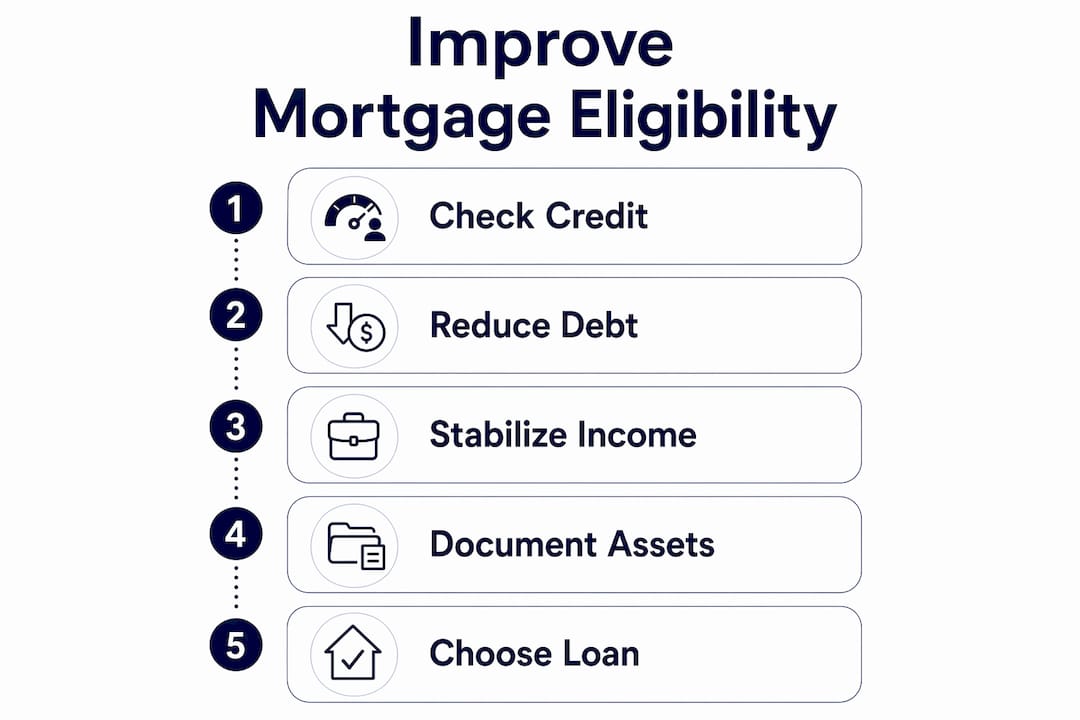
Improving your mortgage eligibility comes down to five moves: lower your credit utilization, reduce your DTI, document stable income, build down-payment reserves, and avoid new credit for 6–12 months before applying.
The fix most buyers overlook
Most eligibility problems I see are not catastrophic. They are fixable, and they follow a pattern: the borrower waited too long to look at their credit, opened a new credit card six months before applying, or never documented the side income they assumed would help.
The sequence that works consistently is straightforward. Stabilize your income first — no job changes, no new business ventures right before applying. Then clear any delinquencies or collections, because those are the items underwriters flag immediately. After that, focus on utilization: get every card below 30% and keep it there. Finally, build your reserves and document every dollar. Walk into pre-approval with two to three months of mortgage payments sitting in a single, clean account.
The borrowers who struggle are usually the ones who try to do everything at once and end up doing nothing well. Pick the highest-impact item for your specific profile and execute it completely before moving to the next one. A broker review six months out tells you exactly which item that is.
Ready to get a clearer picture of your eligibility?
Platinumcapitalfinancial gives Florida homebuyers direct access to multiple lenders and every major loan program — FHA, VA, USDA, conventional, and more — from a single point of contact in Naples. Instead of applying blind and hoping your profile fits, you get a broker who reviews your credit, income, and DTI upfront, tells you what needs to change, and matches you to the lender most likely to approve you on the best terms available.

Bring your most recent pay stubs, two years of W-2s, and a recent bank statement to your first consultation. From there, Platinumcapitalfinancial handles the lender matching, program selection, and pre-approval paperwork. Check current mortgage rates in Naples or get started with a Florida mortgage broker consultation today.
This article is general information, not professional financial or legal advice. Confirm current program rules and eligibility requirements with the relevant program authority or a qualified mortgage professional for your specific situation.
Useful sources
These primary sources back the program rules, underwriting standards, and documentation requirements covered in this guide:
- HUD Mortgage Credit Analysis (HUD 4155.1) — FHA underwriting criteria, compensating factors, and documentation requirements
- VA Home Loan Program — Veterans Affairs — VA loan eligibility, COE process, and lender fee guidance
- Government-Backed Home Loans — USA.gov — Overview of FHA, VA, and USDA program rules and down-payment requirements
- Uniform Residential Loan Application (Form 1003) — FHFA — The standard borrower data form used by all residential lenders
- What Do Mortgage Lenders Look For? — Experian — Credit score thresholds, DTI benchmarks, and income verification guidance
- HUD.gov — FHA program rules, housing counseling resources, and lender guidance
- Consumer Financial Protection Bureau — Credit Repair — How to identify reputable credit counseling vs. scams
For personalized guidance on application timing, compensating factors, and which program fits your profile, consult a licensed mortgage broker before you apply.
Recommended
- Types of Property Eligible for Mortgage in 2026
- Mortgage Underwriting Explained: Your Approval Roadmap
- Common Mortgage Pitfalls Florida Homebuyers Must Avoid
- How to Apply for a Mortgage in Florida: 2026 Guide
Get a free instant rate quote
Take a first step towards your dream home

Free & non binding
No documents required
No impact on credit score
No hidden costs
.svg)
.svg)
.svg)
.svg)

.svg)
