
.svg)
Mortgage News
Mortgage Tax Implications Explained for 2026
Your mortgage does more than put a roof over your head. It can also reduce what you owe the IRS each year, but only if you understand the rules and file correctly. Here is what every homeowner and prospective buyer needs to know about how a mortgage affects your taxes in 2026.
The core tax implications of a mortgage, at a glance:
- Mortgage interest on qualified loans is generally deductible, but only if you itemize on Schedule A of Form 1040
- The deduction limit is $750,000 for mortgages originated after December 15, 2017 ($375,000 if married filing separately)
- Mortgages originated on or before December 15, 2017 carry a higher deduction limit depending on filing status
- Home equity loan and HELOC interest is deductible only when the funds are used to buy, build, or substantially improve the home securing the loan
- Tax benefits apply to your primary residence and one secondary residence
- Property taxes are deductible separately, subject to the $10,000 state and local tax (SALT) cap
- Mortgage refinancing and default each carry distinct tax consequences that catch many homeowners off guard
Reviewed by a CPA. IRS guidelines referenced throughout. All rules reflect the 2026 tax year.
What loan requirements qualify your mortgage for a tax deduction?
Not every mortgage automatically earns you a deduction. The IRS sets specific criteria, and missing any one of them disqualifies the interest you paid.
- Secured debt requirement: The loan must be secured by a qualified home, meaning you signed a mortgage, deed of trust, or land contract that gives the lender a legal claim on the property.
- Qualified home definition: Your main home or one second home qualifies. A "home" includes houses, condominiums, cooperatives, mobile homes, house trailers, and boats, provided the property has sleeping, cooking, and toilet facilities.
- Purpose of the loan: The mortgage must have been taken out to buy, build, or substantially improve the home. Interest on loans used for other purposes, such as paying off credit card debt, is not deductible for tax years after 2017.
- Home equity loans and HELOCs: HELOC interest is deductible only when the borrowed funds go toward buying, building, or substantially improving the home that secures the loan. Using those funds for a vacation or personal expenses eliminates the deduction.
- Homes under construction: You can treat a home being built as a qualified home for up to 24 months, provided it becomes your primary or secondary residence once construction is complete.
- Form 1098 documentation: Your lender typically reports the mortgage interest you paid on Form 1098. If interest is not shown on Form 1098, you can still deduct it, but you must attach a statement to your return explaining the difference.
- Itemization required: You must file Form 1040 or 1040-SR and itemize deductions on Schedule A. If you take the standard deduction, the mortgage interest deduction does not apply.
- Grandfathered debt: Mortgages taken out on or before October 13, 1987 qualify as grandfathered debt. All interest on grandfathered debt is fully deductible, though the balance reduces your available home acquisition debt limit.
Pro Tip: If you own a second home and rent it out part of the year, you must use it personally for more than 14 days or more than 10% of the days it was rented at fair market rate, whichever is greater, to keep the mortgage interest deductible.

How much mortgage interest can you actually deduct?
The deduction limit depends on when you took out your mortgage, not when you file your taxes. Two different thresholds apply, and they do not blend together.
- Post-December 15, 2017 mortgages: The deductible debt limit is $750,000 ($375,000 for married filing separately). Interest on any loan balance above this threshold is not deductible.
- Pre-December 16, 2017 mortgages: The limit is $1,000,000 ($500,000 for married filing separately). Homeowners who locked in before that date keep the higher ceiling.
- Binding contract exception: Certain binding contracts signed before specific IRS deadlines maintain eligibility for the older mortgage deduction limits.
- Combined limit across homes: The deduction limits apply to the combined mortgage balances of your main and qualifying second home.
- Grandfathered debt reduces your room: Mortgages qualifying as grandfathered debt reduce the available deduction limit for newer loans.
- Interest above the limit: Interest paid on mortgage amounts beyond applicable deduction limits is not deductible and cannot be carried over.
- Home equity loans count too: Qualifying home equity loans or HELOCs used for home improvements count toward the applicable deduction limits.
How mortgage points are treated on your tax return
Points are prepaid interest, and the IRS treats them accordingly. Whether you can deduct them all at once or must spread them out depends on the loan type and how the funds were used.
- General rule: Points are deducted ratably over the life of the loan. On a 30-year mortgage, you divide the total points by 360 monthly payments and deduct the portion corresponding to payments made each year.
- Full deduction in the year paid: Certain conditions allow you to deduct all points in the year you paid them. This typically applies to points on a loan used to buy or improve your primary residence, paid directly by you (not rolled into the loan), and consistent with the standard practice in your area.
- Refinancing points: Points paid when refinancing are generally not deductible in full in the year paid. They must be spread over the life of the new loan. If you refinance again or pay off the loan early, any remaining undeducted points become deductible in that year, unless you refinance with the same lender.
- Home equity loan points: Points on a home equity loan are not deductible at all if the proceeds were not used to buy, build, or substantially improve the home. The use-of-funds rule applies here just as it does to interest.
- Points not on Form 1098: Report these on Schedule A, line 8c, labeled "Points not reported to you on Form 1098." Attach a statement if needed.
- Early payoff: If you sell the home or pay off the mortgage before the loan term ends, you can deduct all remaining unamortized points in that tax year, with the same-lender refinancing exception noted above.
How to claim the home mortgage interest deduction on your return
Claiming the deduction correctly comes down to using the right forms and putting numbers on the right lines. A small filing error can cost you the deduction entirely.
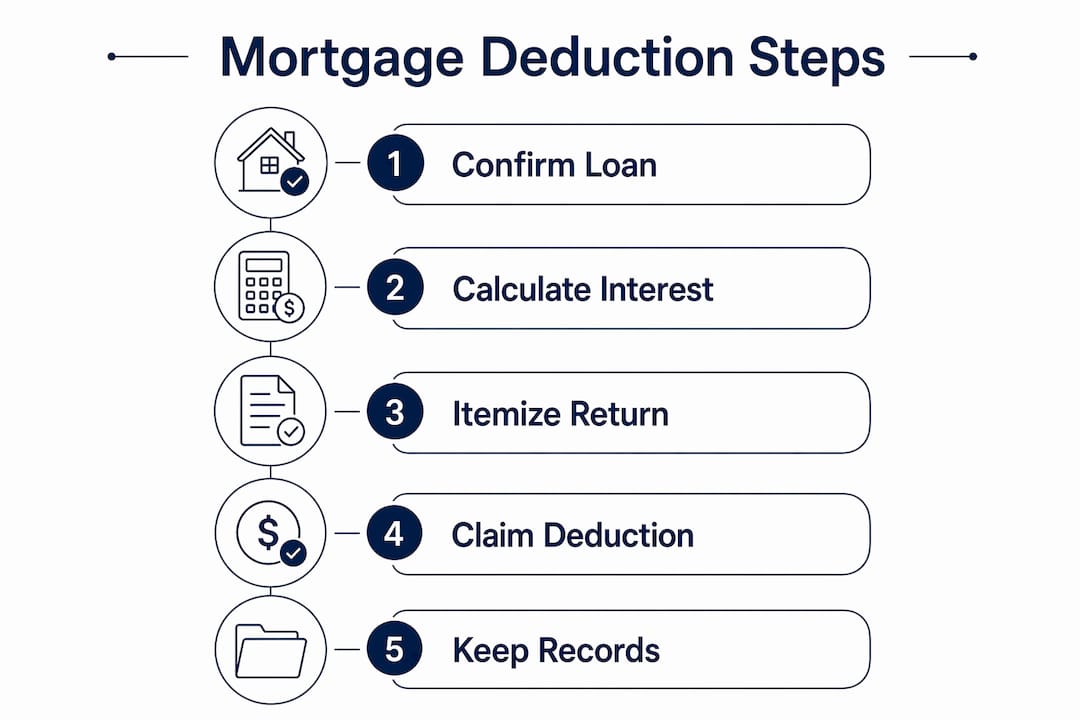
- File Schedule A: Attach Schedule A to Form 1040 or 1040-SR. This is where all itemized deductions live, including mortgage interest, points, and property taxes.
- Use Form 1098: Your lender sends Form 1098 by January 31 each year, reporting the total mortgage interest you paid. Enter the amount from box 1 on Schedule A, line 8a.
- Interest not on Form 1098: If you paid deductible interest that your lender did not report on Form 1098, enter it on line 8b and attach a written statement explaining the discrepancy. Write "See attached" next to line 8b on paper returns.
- Points: Deductible points appear on line 8a if shown on Form 1098, or on line 8c if not reported there.
- Standard deduction comparison: For 2026, the standard deduction is set at levels that exceed the mortgage interest many homeowners pay, particularly those with smaller loan balances or lower interest rates. Run the numbers both ways before committing to itemizing.
- Property taxes: State and local real property taxes go on Schedule A, line 5b. The combined SALT deduction (state income or sales taxes plus property taxes) is capped at $10,000 ($5,000 married filing separately).
- Recordkeeping: Keep Form 1098, closing disclosure documents, receipts for home improvements, and bank statements for at least three years after filing. If you claimed a deduction tied to a home improvement, keep those records for as long as you own the property.
Pro Tip: If your mortgage balance is close to the $750,000 limit, calculate your average mortgage balance for the year rather than using the year-end balance. The IRS uses the average balance to determine how much interest is deductible.
Expert tips and common misconceptions about mortgage tax benefits
The mortgage interest deduction is one of the most misunderstood tax benefits in the US tax code. Getting it wrong costs money, either by missing a legitimate deduction or by claiming one you do not qualify for.
- The deduction is not automatic. Many homeowners assume mortgage interest is automatically deductible. It is not. Itemization is required, and for a large share of taxpayers, the standard deduction is larger than their total itemized deductions, making the mortgage interest deduction irrelevant in practice.
- Standard deduction often wins. After the Tax Cuts and Jobs Act nearly doubled the standard deduction, fewer homeowners benefit from itemizing. If your mortgage interest, property taxes, and other itemized deductions combined do not exceed the standard deduction for your filing status, you gain nothing from itemizing.
- HELOC interest has a hard condition. Borrowers frequently assume all HELOC interest is deductible. The IRS focuses entirely on how the funds were used. Interest on HELOC funds spent on a kitchen remodel qualifies; interest on the same HELOC used to pay off car loans does not. Clear documentation tying each expenditure to a qualifying home improvement is required.
- "Substantial improvement" has a specific meaning. Routine maintenance, like painting a room or replacing a broken appliance, does not qualify. A substantial improvement must add value to the home, extend its useful life, or adapt it to a new use. Adding a bedroom, installing a new roof, or building a deck generally qualifies. Fixing a leaky faucet does not.
- Second homes rented out require a personal use test. If you rent your second home and want to deduct the mortgage interest, you must use it personally for more than 14 days or more than 10% of the days it was rented at fair market rate, whichever is greater. Miss that threshold and the property is classified as a rental, not a second home, and different rules apply.
- Tax benefits should not drive mortgage decisions. Relying on tax deductions as the primary reason to take on a mortgage or HELOC is a financial mistake. The deduction reduces your taxable income, not your tax bill dollar for dollar. Borrowing $100,000 to get a deduction on the interest rarely pencils out as a net gain.
- Mixing funds kills the deduction. If you deposit HELOC proceeds into a general account and use that account for both home improvement payments and personal expenses, tracing which dollars went where becomes nearly impossible. Keep improvement funds in a dedicated account and pay contractors directly from it.
- Mortgage credit certificates (MCCs) offer a different benefit. If a state or local government issued you a Mortgage Credit Certificate, you may qualify for a tax credit (not just a deduction) on a portion of your mortgage interest. Use Form 8396 to calculate it. A credit reduces your tax bill directly, dollar for dollar, which makes it more valuable than a deduction of the same amount.
Pro Tip: Maintain a dedicated folder, physical or digital, with contracts, contractor invoices, bank statements, and before-and-after photos for every home improvement project. If the IRS ever questions your HELOC interest deduction, this documentation is your defense. You can use a HELOC payment calculator to model how much interest you might pay and whether the deduction is worth pursuing.

Key Takeaways
Mortgage interest is deductible only when you itemize, and the $750,000 debt limit (for loans after December 15, 2017) caps how much interest qualifies, making it critical to run the numbers before filing.
Ready to structure your Florida home loan with tax efficiency in mind?
Understanding the tax implications of your mortgage is one part of the equation. Choosing the right loan structure is the other. At Platinumcapitalfinancial, we work with Florida homebuyers and homeowners to find loan options that fit their financial picture, whether that is a fixed-rate mortgage in Florida, an FHA loan, a VA loan, or a construction loan for a home you are building from the ground up.

If you are buying in Collier County or anywhere across Florida and want to talk through how your loan type affects your tax position, our team is ready to help. Reach out to Platinumcapitalfinancial and get a conversation started before your next tax year begins.
Recommended
- Mortgage term explained: A clear guide for Florida buyers
- FRM FAQ's
- Types of Property Eligible for Mortgage in 2026
- Reverse Mortgages
Get a free instant rate quote
Take a first step towards your dream home

Free & non binding
No documents required
No impact on credit score
No hidden costs
.svg)
.svg)
.svg)
.svg)

.svg)
