
.svg)
Mortgage News
Loan Estimate Explained: A Complete Homebuyer Guide
What is a loan estimate and what does it tell you?
A Loan Estimate is a standardized three-page form that every mortgage lender must give you within three business days of receiving six key pieces of information: your name, income, Social Security number, the property address, an estimated property value, and the loan amount you want. That’s it. You don’t need a signed purchase contract. You don’t need to have chosen a lender yet.
The form shows your estimated interest rate, monthly payment, total closing costs, taxes, insurance, and any special loan features that carry risk. Because the Consumer Financial Protection Bureau (CFPB) requires all lenders to use the exact same format under the TRID rule (which combines TILA and RESPA disclosures), you can place two Loan Estimates side by side and compare them line by line.
One thing to get straight from the start: receiving a Loan Estimate does not mean loan approval. The lender is showing you what terms they expect to offer if you move forward. Nothing is locked in yet unless the form explicitly says so.
The Loan Estimate is also different from the Closing Disclosure, which comes later. The Closing Disclosure is a five-page form you receive at least three business days before closing. It shows your actual, final loan terms. Your job at that stage is to compare it carefully against your Loan Estimate to make sure nothing changed unexpectedly.
Key information found on a Loan Estimate:
- Loan amount, interest rate, and whether the rate can increase after closing
- Monthly principal and interest payment
- Estimated total monthly payment (including taxes, insurance, and mortgage insurance)
- Total estimated closing costs and cash to close
- Risky loan features: prepayment penalty, balloon payment, negative amortization
- Whether the interest rate is locked or floating
- Projected five-year costs and APR for comparison
How to read page 1 of the Loan Estimate
Page 1 packs in the most critical numbers. Get comfortable with it before you look at anything else.

The top of the page confirms your basic loan details: loan term (say, 30 years), loan purpose (purchase or refinance), loan product (fixed or adjustable), and loan type (conventional, FHA, VA, etc.). Check these first. If anything differs from what you discussed with the loan officer, call immediately.
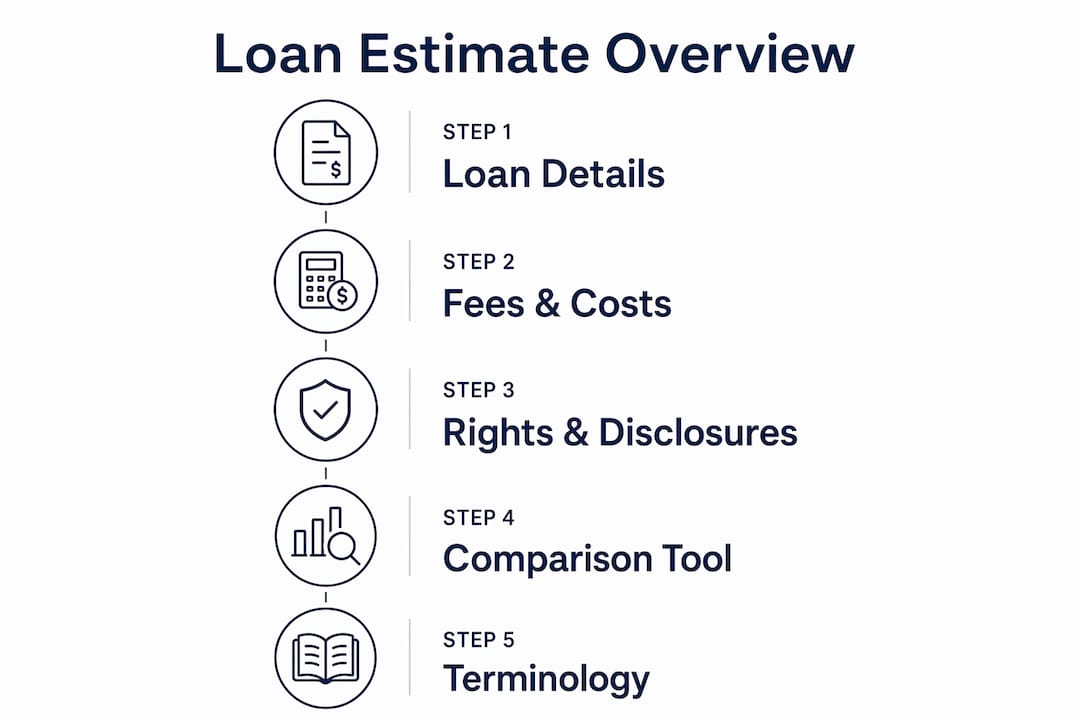
The “Projected Payments” section splits your monthly cost into layers. The principal and interest figure is the core number. On top of that, you may see mortgage insurance (typically required when your down payment is below 20% of the home price) and an escrow amount covering property taxes and homeowner’s insurance. The total of all three is your Estimated Total Monthly Payment.
Risky loan features appear in the Loan Terms box on page 1. A prepayment penalty means the lender can charge you a fee for paying off the mortgage early. Negative amortization means your loan balance can actually grow even when you make payments on time. A balloon payment means a large lump sum is due at the end of the loan term. If any of these show “YES,” ask the lender to provide a second Loan Estimate for a loan without that feature so you can see the cost difference.
The rate lock status sits in the top right corner of page 1. Interest rates shown on the Loan Estimate are not guaranteed unless the rate is explicitly locked. If the form says the rate is not locked, market movement between now and closing could change what you pay every month for the life of the loan.
What page 2 reveals about fees and closing costs
Page 2 is where the money lives. This is the page to study when you’re comparing offers from multiple lenders.

The page organizes costs into lettered sections. Section A covers origination charges, which are the upfront fees your lender charges directly. Section B lists services the lender selects, such as the appraisal and credit report. Section C covers services you can shop for yourself, like title insurance and settlement agents.
When comparing closing costs, focus on the fees that vary by lender: Section A origination charges, Section B services, and Section J lender credits. Taxes, government fees, and prepaids are largely outside the lender’s control, so differences there don’t reflect lender pricing.
Lender credits (Section J) deserve a close look. A credit means the lender gives you money back to offset closing costs, but you typically pay a higher interest rate in exchange. Ask whether a version of the loan without credits is available at a lower rate, and run the math on which option costs less over your expected time in the home.
The bottom of page 2 shows your Estimated Cash to Close. This is the total you’ll need to bring to the closing table, calculated as your down payment plus closing costs minus any deposits already paid and any seller credits. You typically need a cashier’s check or wire transfer for this amount. Confirm you have those funds available and that you can document their source.
Pro Tip: “No closing cost” loans aren’t free. The lender rolls those costs into a higher interest rate, which means you pay more every month for the life of the loan. Run a break-even calculation before choosing that option.
What page 3 tells you about your rights and long-term costs
Page 3 is the most overlooked section of the Loan Estimate, and that’s a mistake. It contains disclosures that protect you and numbers that help you compare loans over time.
The Comparisons box is the most useful part. It shows your projected five-year costs and the estimated principal you’ll have paid off after five years. Subtract the principal paid from the total paid, and you get your five-year cost of borrowing. That single figure lets you compare two loans with different rates and fee structures on equal footing.
What page 3 covers:
- Contact information: Lender name, loan officer name, NMLS ID numbers, and contact details. Verify these match who you've been speaking with.
- Comparisons section: APR, total interest percentage (TIP), and the five-year cost projection described above.
- Other considerations: Whether the loan is assumable, late payment fees, and whether the lender intends to service the loan or transfer it to another company after closing.
- Loan servicer disclosure: If the lender plans to sell or transfer your loan, this page says so. Your payments could go to a different company after closing.
- Confirm no errors: Check your name spelling, the property address, and the loan amount. A typo in the property address is not a minor clerical issue. It can affect your rate and costs.
The APR on page 3 is higher than the interest rate on page 1, and that’s normal. APR includes the interest rate plus lender fees spread over the loan term, so it reflects the true annual cost of borrowing. Use APR to compare loans with different fee structures, since a loan with a lower rate but high fees can have a higher APR than one with a slightly higher rate and lower fees.
The “Other Considerations” section also tells you whether the loan is assumable, meaning a future buyer could potentially take over your mortgage. For most conventional loans, this is not allowed. FHA and VA loans typically are assumable, which can be a selling point if rates rise.
How to use your Loan Estimate to compare mortgage offers
The Loan Estimate’s biggest advantage is that every lender uses the same form. That uniformity is your leverage.
Request Loan Estimates from at least three lenders for the same loan type and amount. Ask for them on the same day or within a day or two, since interest rates move daily and you want a fair comparison. Once you have them, lay them side by side.
What to compare across Loan Estimates:
- Interest rate and rate lock status: Is the rate locked? If not, both rates could change before you close.
- Monthly principal and interest: This is the cleanest comparison point. Taxes and insurance estimates can vary by lender assumption, so the total monthly payment can be misleading. Isolate principal and interest for a true apples-to-apples read.
- Origination charges (Section A): These are entirely within the lender's control and the most negotiable line on the form.
- Lender credits (Section J): A higher credit means a higher rate. Decide whether you want to pay more upfront or more monthly.
- Five-year cost of borrowing (page 3): Especially useful when comparing a loan with points against one without.
- Risky features: If one lender's offer includes a prepayment penalty and another's doesn't, that's a meaningful difference in risk.
Once you’ve identified the best offer, use the others as negotiating tools. Lenders will often match or beat a competitor’s origination charges when you show them a better offer in writing. The CFPB notes that negotiating after you have a signed purchase contract tends to produce the best results, since the timeline pressure is real and lenders know you’re serious.
If a Loan Estimate doesn’t reflect what you discussed with the loan officer, ask why in writing. A significant discrepancy could be a miscommunication, or it could be a sign to move on to another lender. You can also submit a complaint to the CFPB if a lender charges fees beyond a credit report fee before issuing your Loan Estimate, which is against federal law.
Pro Tip: Share the actual property tax and HOA figures with every lender before requesting your Loan Estimates. The more accurate the inputs, the more comparable the outputs.
Key terms you’ll find on the Loan Estimate form
Reading a Loan Estimate gets easier once you know what the jargon actually means. Here are the terms that trip up most homebuyers.
APR (Annual Percentage Rate): The true annual cost of the loan, expressed as a percentage. It includes the interest rate plus most lender fees spread over the loan term. Always higher than the stated interest rate.
Origination charges: Upfront fees the lender charges to process and underwrite your loan. Can include points, application fees, and underwriting fees. Fully negotiable.
Escrow: An account held by a third party (usually the lender’s servicer) that collects a portion of your monthly payment to cover property taxes and homeowner’s insurance when those bills come due.
Loan term: The length of time you have to repay the loan. Common terms are 15 and 30 years. A shorter term means higher monthly payments but less total interest paid.
Prepayment penalty: A fee the lender charges if you pay off the loan early, whether through refinancing or selling the home. Not common on conventional loans but worth checking.
Balloon payment: A large lump-sum payment due at the end of the loan term. If you can’t make it or refinance, you could lose the home.
Negative amortization: When your monthly payment is less than the interest owed, the unpaid interest gets added to your loan balance. Your debt grows even as you make payments.
Lender credits: Money the lender gives you to offset closing costs, in exchange for a higher interest rate.
Interest rate lock: A lender’s commitment to hold a specific rate for a set period, typically 30–60 days. If your rate is not locked, it can change before closing.
Good faith estimate: The predecessor to the Loan Estimate, used before the TRID rule took effect in 2015. You may still hear this term, but the Loan Estimate replaced it entirely.
Tolerance limits: Under TRID rules, certain fees on the Loan Estimate cannot increase at closing, some can increase by up to 10%, and others can change freely. Origination charges in Section A have zero tolerance, meaning they cannot increase at all once disclosed.
Signing the Loan Estimate: Signing does not bind you to the lender or the loan. It only acknowledges that you received the form. You are not committed until you sign final closing documents.
A closer look at what page 3 of the Loan Estimate contains
Page 3 rounds out the form with disclosures that most borrowers skim past. Don’t.
The top of page 3 lists the lender’s contact information alongside the loan officer’s name and NMLS license number. Cross-check these against the business card or email you received. An NMLS number you can verify at the Nationwide Multistate Licensing System confirms the loan officer is licensed to operate in your state.
The Comparisons section gives you three numbers: APR, total interest percentage, and the five-year cost figure. The total interest percentage (TIP) shows the total amount of interest you’ll pay over the full loan term as a percentage of the loan amount. On a 30-year mortgage, this number can be surprisingly large. It’s a useful gut-check on how much a lower rate actually saves you over time.
Under “Other Considerations,” the servicing disclosure tells you whether the lender plans to keep your loan or sell it. Roughly two-thirds of mortgages are sold to other servicers after closing. That doesn’t change your loan terms, but it does mean your payment address and customer service contact will change. Knowing this upfront prevents confusion later.
The confirm receipt section at the bottom is where your signature goes. As noted, signing here only confirms you received the Loan Estimate within the required three-business-day window. It is not a loan commitment, and it does not obligate you to proceed with that lender.
Key Takeaways
The Loan Estimate is the most powerful comparison tool a homebuyer has, and reading it carefully before committing to any lender can save you thousands over the life of your loan.
Ready to get your Loan Estimate in Florida?

Platinumcapitalfinancial works with homebuyers across Florida to find the right loan and walk you through every line of your Loan Estimate before you commit to anything. Whether you’re looking at a fixed-rate mortgage, an FHA loan, or a VA loan, the team at Platinumcapitalfinancial can pull Loan Estimates from multiple lenders so you can compare real numbers side by side.
Florida buyers have specific considerations, from property tax estimates in Collier County to homeowner’s insurance costs that vary significantly by location. Getting those figures right on your Loan Estimate from the start means fewer surprises at closing.
Reach out to Platinumcapitalfinancial today through our Florida mortgage broker page to request your Loan Estimates and start comparing offers with confidence.
Recommended
- What Is the Home Loan Process: A 2026 Guide
- Mortgage term explained: A clear guide for Florida buyers
- Builder Loan Calculator for Construction Financing Costs
- Loan Amortization Calculator | Mortgage Payoff Estimate
Get a free instant rate quote
Take a first step towards your dream home

Free & non binding
No documents required
No impact on credit score
No hidden costs
.svg)
.svg)
.svg)
.svg)

.svg)
