
.svg)
Mortgage News
Collier County Property Taxes: What Homeowners Must Know
Collier County property taxes are annual ad valorem taxes levied on real estate in the Naples area, calculated by multiplying your taxable value by a combined millage rate set by local authorities. Your first move: verify your assessed value and homestead status at the Collier County Property Appraiser.
Table of Contents
- How Collier County property taxes actually work
- Platinumcapitalfinancial helps you plan for Collier County taxes before you close
- Key Takeaways
How Collier County property taxes actually work
Three separate offices handle your tax bill, and confusing them costs homeowners money.
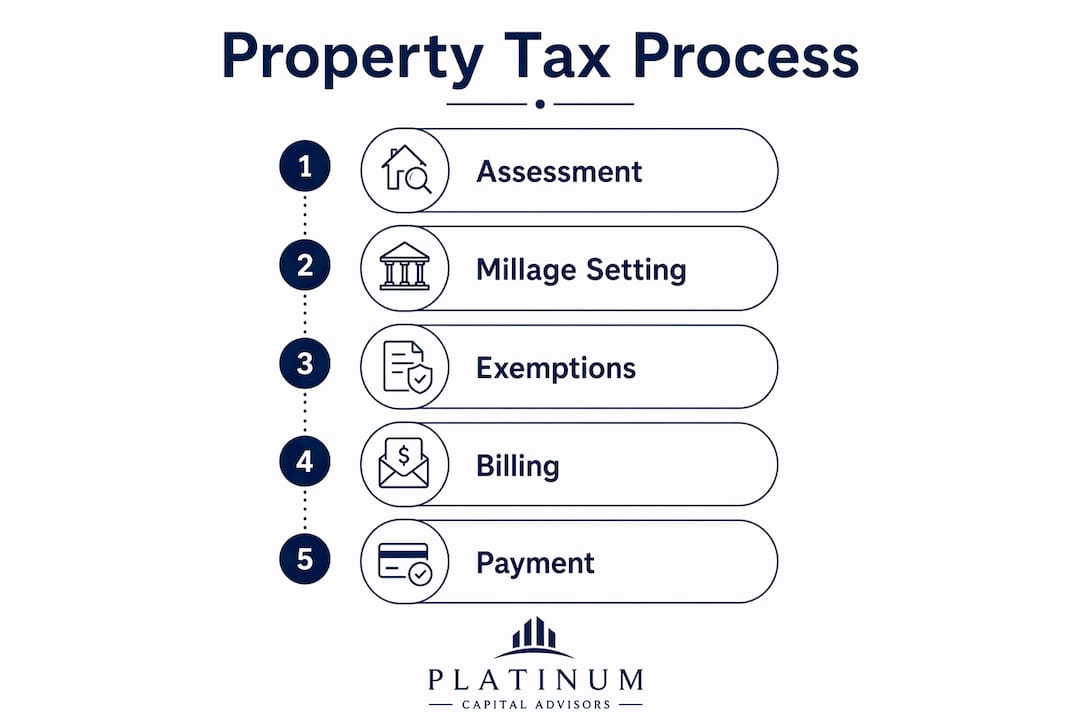
The Property Appraiser determines market value as of January 1 each year — that is the starting point, not the final number. The Board of County Commissioners, Collier County Public Schools, and other local taxing authorities then set millage rates independently. The Tax Collector sends the bill and collects payment. One office assesses, others set rates, one collects.
The calculation formula:
Assessed Value − Exemptions = Taxable Value × Millage Rate ÷ 1,000 = Annual Tax Bill
Labeled example: A home with a $350,000 assessed value, a $50,000 homestead exemption, and a combined millage rate of 10.00 mills produces a taxable value of $300,000 and an annual bill of $3,000.
Key taxing authorities on a typical Collier County bill:
- Collier County Public Schools (Required Local Effort plus voter-approved referendums)
- Collier County general fund, library, and MSTU
- Water management districts (Big Cypress Basin)
- City millage where applicable (Naples, for example)
Pro Tip: Because the Property Appraiser only sets value while separate authorities set millage rates, your assessed value can stay flat and your bill can still rise if local governments increase budgets. Check both numbers every August when TRIM notices arrive.
Homestead exemption and Save Our Homes protection
Florida law grants a standard homestead exemption of up to $50,000: the first $25,000 applies to all levies including school taxes; the second $25,000 applies only to non-school levies on assessed value above $50,000. File Form DR-501 with the Collier County Property Appraiser by the March 1 deadline to qualify for that year’s exemption.

Once homestead is established, Save Our Homes caps assessed-value increases at a low annual rate or the rate of inflation, whichever is lower. After several years, homesteaded owners often carry assessed values below market value, which directly stabilizes mortgage escrow payments. The cap resets to full market value when the property sells — buyers of long-held homes should be prepared for a notable first-year tax increase.
Moving within the county does not transfer your exemption automatically. File a new homestead application for the new property. Closed after March 1? You can pre-file for the following year any time after March 1.
Additional exemptions worth checking: senior (65+ with qualifying income), 100% disabled veterans (full exemption on homesteaded residence), and partial disability ($5,000 exemption).
Payment schedule, delinquency, and tax liens
The Collier County Tax Collector mails bills November 1. Pay early and save:
Taxes unpaid past April 1 enter a tax certificate process that can eventually lead to a forced property sale. Post-dated checks are not accepted — funds must be available at submission.
How property taxes affect your mortgage escrow
Lenders divide your annual tax bill by 12 and add it to your monthly payment. On a $3,000 annual bill, that is $250 per month in escrow. If your assessed value jumps after purchase — especially common when buying a previously homesteaded home — expect an escrow shortage notice and a payment adjustment. Run the numbers before you lock a rate, not after.
To appeal an assessment, file a petition with the Value Adjustment Board within 25 days of receiving your TRIM notice (mailed mid-August). The filing fee is typically $15 per parcel.
Platinumcapitalfinancial helps you plan for Collier County taxes before you close
Property taxes can add hundreds of dollars to a monthly mortgage payment, and most buyers find that out too late. Platinumcapitalfinancial works with Collier County homebuyers to model escrow scenarios before closing — so the tax line on your payment never comes as a surprise.

Loan officer Chuck Barnes provides rate quotes, pre-approvals, and side-by-side payment comparisons across fixed-rate mortgages, FHA, VA, and adjustable-rate products, each with local tax exposure factored in. Whether you are buying in Naples or refinancing an existing Collier County home, Platinumcapitalfinancial gives you a clear picture of total monthly cost — principal, interest, insurance, and taxes together. Contact Platinumcapitalfinancial today for a Florida mortgage consultation tailored to your parcel.
Key Takeaways
Collier County property taxes are calculated on taxable value after exemptions, with homestead and Save Our Homes protections offering the most significant long-term savings for owner-occupants.
This article is general information, not tax or legal advice. Confirm current rates, exemption eligibility, and deadlines with the Collier County Property Appraiser, Tax Collector, or a qualified professional for your specific situation.
Recommended
Get a free instant rate quote
Take a first step towards your dream home

Free & non binding
No documents required
No impact on credit score
No hidden costs
.svg)
.svg)
.svg)
.svg)

.svg)
