
.svg)
Mortgage News
Cash Out vs HELOC: Which One Should You Choose?
If your existing mortgage rate is below 5%, a HELOC or home equity loan almost always wins. A cash-out refinance makes sense when current rates are at or below your existing rate, or when you need a very large lump sum and want one consolidated payment. The math behind that verdict is straightforward, and it comes down to one key fact: a cash-out refi applies its new rate to your entire mortgage balance, not just the money you’re pulling out.
Say you owe $350,000 at 3.25% and want $80,000 for a kitchen remodel. A cash-out refinance would replace your $350,000 balance with a $430,000 loan at today’s rates, which run materially higher than 3.25%. Every dollar of that original $350,000 gets repriced upward. A HELOC or home equity loan, by contrast, leaves your 3.25% first mortgage untouched and only charges the higher rate on the new $80,000. That difference in how the rate applies is where most homeowners miscalculate the long-term interest cost.

Three fastest ways to decide which to model first:
- Your current mortgage rate is below 5%? Start with a HELOC or home equity loan.
- You need cash in stages or aren't sure of the final amount? HELOC.
- Your existing rate is above current market rates, or you need $150,000+? Run the cash-out numbers.
Pro Tip: Before calling a lender, pull your mortgage statement and write down your current rate, remaining balance, and remaining term. Those three numbers determine 80% of the decision.
Table of Contents
- How does each product actually work as a loan?
- How do you actually receive the money?
- What do rates actually look like, and how do you stress-test a HELOC?
- What does setup actually cost for each option?
- What are the repayment risks you need to plan for?
- Who qualifies, and how much can you actually borrow?
- What are the tax rules, and what does the IRS actually say?
- How do you decide? A checklist and four real scenarios
- Key Takeaways
- The math most homeowners skip
- Platinum Capital Advisors runs the numbers for Florida homeowners
- Useful sources and further reading
How does each product actually work as a loan?
A cash-out refinance is a brand-new first mortgage. Your old loan is paid off at closing, and you walk away with a single, larger loan at a new rate and a new term, typically 15 or 30 years. The lender holds a first lien on your home, and you make one monthly payment going forward.

A HELOC is a revolving second lien, similar in structure to a credit card secured by your home. The CFPB defines it as a line of credit you draw from during a set draw period, usually 5–10 years, then repay over a repayment period of 10–20 years. Rates are typically variable, tied to the Prime rate. A home equity loan is also a second lien, but it delivers a fixed lump sum with a fixed rate and a fixed monthly payment from day one.
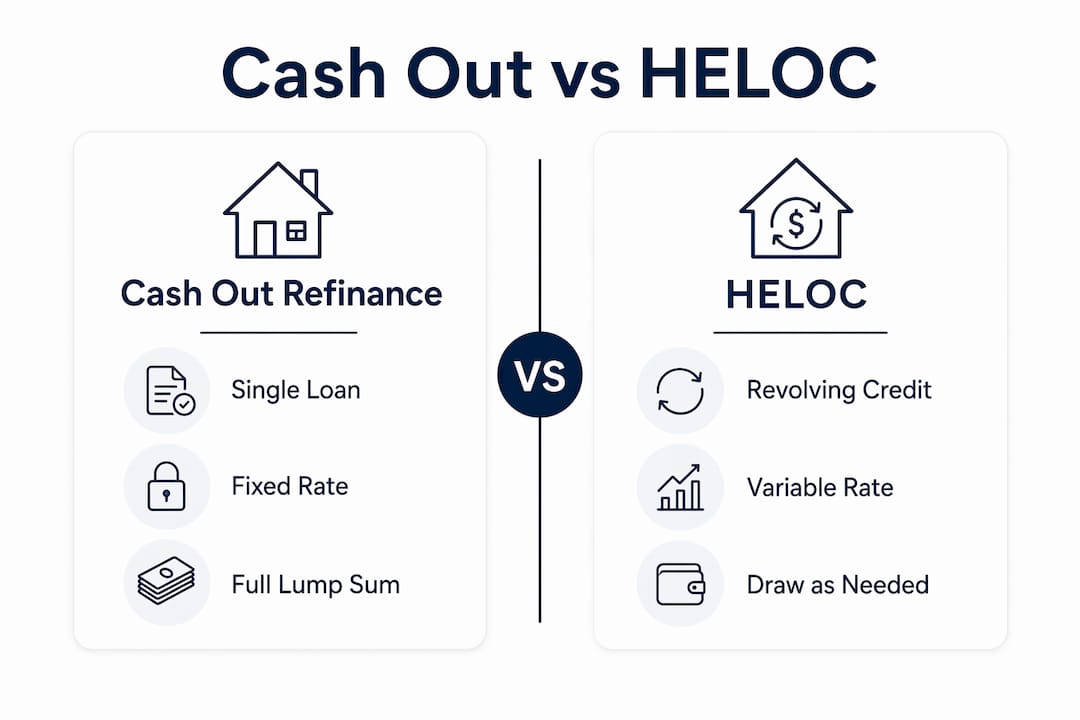
Practically, a cash-out refi means one payment; a HELOC or home equity loan means two payments (your original mortgage plus the new second lien). That two-payment structure is worth noting because it affects your debt-to-income ratio and your monthly cash flow.
Pro Tip: The “reset-the-clock” effect on amortization is real. If you have 22 years left on a 30-year mortgage and you do a cash-out refi into a new 30-year loan, you’ve just added 8 years of interest payments to your total cost — even before factoring in the rate change.
How do you actually receive the money?
The funding delivery model matters as much as the rate, because it determines how much interest you start paying immediately.
With a cash-out refinance, the full amount lands in your account at closing. You’re paying interest on all of it from day one, whether you spend it in week one or month six.
A HELOC works differently. You draw only what you need, when you need it, and pay interest only on amounts drawn during the draw period. If you open a $100,000 HELOC and draw $30,000 in month one, you owe interest on $30,000, not $100,000. That makes HELOCs the better tool for phased or uncertain spending.
A home equity loan, like a cash-out refi, gives you the full amount at closing with fixed amortization starting immediately.
Which funding model fits which project:
- Single large project with a known cost (roof replacement, full kitchen gut): Cash-out refi or home equity loan. You need the full amount now.
- Phased renovation (addition built over 18 months): HELOC. Draw as contractors invoice.
- Emergency liquidity cushion: HELOC. Keep the line open and draw only if needed.
- High-interest debt consolidation: Cash-out refi or home equity loan. A fixed rate and fixed payoff date work better than a revolving line for this goal.
Pro Tip: If you open a HELOC for emergencies and never draw on it, you pay nothing. That optionality has real value — but only if you have the discipline not to treat it as spending money.
What do rates actually look like, and how do you stress-test a HELOC?
Fixed-rate cash-out refinances typically carry lower headline rates than second-lien products, but that comparison is misleading without the balance context covered above. The rate on a cash-out refi applies to your full new balance; the rate on a HELOC applies only to what you draw.
HELOCs are priced on a Prime-plus model. With Prime observed near 6.75% in May 2026, most quoted HELOC lines run roughly 6.75%–8.75% depending on credit score and lender. Home equity loans with fixed rates typically land in a similar range or slightly above. Cash-out refi rates vary by loan size, LTV, and credit profile.
Add 2 percentage points to your quoted rate and recalculate the monthly payment on your full drawn balance during the repayment period. If that payment is uncomfortable, either reduce the draw amount or consider a fixed-rate home equity loan instead.
Recent market data shows average HELOC rates fell more than two percentage points compared with 18 months prior, which has made them more competitive over short hold periods. But variable rates can reverse. A borrower who drew $80,000 on a HELOC at 7% and sees rates climb to 9% faces a meaningfully higher repayment-period payment than they planned for.
What does setup actually cost for each option?
Closing costs are where cash-out refinances lose ground quickly. Typical ranges: cash-out refinances run 3–6% of the new loan amount; home equity loans run 1–3% of the second loan; HELOCs often carry $0–$995 in upfront fees, with many lenders waiving them entirely.
| Appraisal | $0–$995 | — | — (sometimes waived) | | Origination / points | — | — | $0–$995 | | Title and escrow | — | — | — | | Recording fees | $100–$200 | $100–$200 | $100–$200 | | Estimated total | — | — | $0–$995 |
Sample figures for illustration; actual costs vary by lender, state, and loan size.
The break-even calculation matters here. If a cash-out refi saves you $200/month versus keeping your current mortgage plus a HELOC, but costs $15,000 to close, you need 75 months (over 6 years) just to recover the closing costs. If you plan to sell or refinance again before that, the refi likely costs more in total.
What are the repayment risks you need to plan for?
The HELOC draw period is the part most borrowers underestimate. During the draw period, many lenders require interest-only payments. That keeps the monthly bill low and comfortable. When the repayment period starts, you’re suddenly amortizing the full drawn balance over 10–20 years, and the payment can jump substantially.
A cash-out refinance carries a different risk: restarting amortization. In the early years of any mortgage, most of your payment goes to interest, not principal. If you refinance 10 years into a 30-year loan, you reset that interest-heavy front end. Over a 10-year hold period, that can cost tens of thousands of dollars in extra interest even if the rate itself is reasonable.
Common borrower mistakes:
- Assuming HELOC rates will stay flat through the repayment period.
- Ignoring the amortization reset when comparing a cash-out refi to a second-lien option.
- Drawing the full HELOC line immediately, eliminating the interest-savings advantage.
- Not having a payback plan tied to a specific event (bonus, home sale, rental income).
Payment shock is the most common HELOC regret. A borrower who draws $90,000 at 7.5% on an interest-only basis pays about $563/month during the draw period. When the 20-year repayment period starts, that same balance amortizes to roughly $724/month — a 28% jump, before any rate increase.
Pro Tip: If you use a HELOC, treat the draw period as if it were already in repayment. Make principal payments from the start. You’ll reduce the balance before the payment shock hits and pay far less interest overall.
Who qualifies, and how much can you actually borrow?
Both products require a home appraisal, a credit check, and income documentation. Lenders typically want:
- Credit score: 680+ for most HELOC and home equity loan approvals; 700+ for better pricing. Cash-out refis follow similar guidelines, though FHA and VA products have lower floors.
- DTI (debt-to-income ratio): Generally 43% or below, including the new payment.
- Seasoning: Most lenders require you to have owned the home for at least 6–12 months.
- Documentation: W-2s, two years of tax returns, recent pay stubs, and bank statements.
The key number is your combined loan-to-value ratio (CLTV). HELOCs and home equity loans commonly allow up to 80–85% CLTV. Cash-out refinances follow similar limits, though conventional loans typically cap at 80% LTV.
How to calculate your available equity:
- Get a current estimate of your home's market value (a recent appraisal or a lender's automated valuation).
- Multiply by 0.80 (or 0.85 if your lender allows it): that's your maximum total debt allowed.
- Subtract your current mortgage balance: the result is your maximum available cash
Example: $500,000 home × 0.80 = $400,000 maximum debt. Current balance: $310,000. Available cash: $90,000.
Appraisals add 2–4 weeks to the timeline for any product. HELOCs sometimes use automated valuations for smaller lines, which can cut that wait. A full cash-out refinance typically closes in 30–45 days; a HELOC can close in as little as 2–3 weeks with a cooperative lender.
Pro Tip: If you’re in a rising-value market like many Florida coastal areas, a fresh appraisal often comes in higher than online estimates. That extra value directly increases your available borrowing room.
What are the tax rules, and what does the IRS actually say?
IRS Publication 936 is the governing document here, and the rule is the same for every product: interest is deductible only if the loan proceeds are used to buy, build, or substantially improve the home that secures the loan. The deduction does not depend on whether you used a HELOC, a home equity loan, or a cash-out refinance. It depends entirely on what you did with the money.
Per IRS Publication 936: Interest on home equity debt is deductible as home mortgage interest only when the proceeds are used to “buy, build, or substantially improve” the taxpayer’s home that secures the loan. Using proceeds for debt consolidation, tuition, or other personal expenses disqualifies the interest from deduction.
That means a homeowner who uses a HELOC to remodel their kitchen can deduct the interest. The same homeowner who uses a HELOC to pay off credit cards cannot. The CFPB’s consumer guidance on home equity products reinforces this: understand your use of proceeds before assuming a tax benefit.
Regulatory checklist before closing:
- Confirm your intended use of proceeds qualifies under IRS Pub 936 with a tax advisor.
- Check for prepayment penalties, especially on home equity loans.
- Review state-specific disclosure requirements (Florida has its own right-of-rescission rules for second liens).
- Ask your lender for the APR, not just the rate, to capture all fees in one comparable number.
This article is general information, not tax or legal advice. Confirm your specific situation with a qualified tax professional and review current IRS guidance directly.
How do you decide? A checklist and four real scenarios
Work through these yes/no questions before you call a lender:
- Is your current mortgage rate below 5%? If yes, lean toward a second-lien product.
- Do you know the exact amount you need, or is it a range? Range = HELOC.
- Can you handle a variable rate that could rise 2–3 points? No = home equity loan or cash-out refi.
- Are you comfortable restarting mortgage amortization? No = second-lien product.
- Do you plan to stay in the home long enough to recover closing costs? Short timeline = HELOC.
Four scenarios:
Scenario A — Low-rate homeowner, $80k kitchen remodel. Existing rate: 3.25%. A cash-out refi at today’s rates reprices the full $350,000 balance upward. A home equity loan at 8% on just the $80,000 costs far less in total interest. Recommendation: home equity loan.
Scenario B — Phased addition, $40k–$100k over 18 months. The final cost is uncertain. A HELOC lets the homeowner draw $40,000 now and pull more as needed, paying interest only on what’s drawn. Recommendation: HELOC.
Scenario C — Debt consolidation, $60k in high-interest credit cards. A fixed-rate home equity loan at 8% beats 22% credit card rates and provides a defined payoff date. Note: interest is not deductible for this use under IRS Pub 936. Recommendation: home equity loan.
Scenario D — Recent high-rate mortgage. Homeowner bought in 2023 at 7.5%. Current market rates are below that. A cash-out refi can lower the rate on the full balance and pull equity simultaneously. Recommendation: cash-out refinance.
Average HELOC rates have dropped meaningfully from their recent peak, which makes Scenario B and C more attractive on a HELOC than they were 18 months ago. Still, hold period matters more than headline rate. If you’ll repay within 5 years, a HELOC’s lower upfront cost often wins even at a slightly higher rate.
Pro Tip: Ask every lender for the APR (not just the rate), the break-even month on closing costs, and whether the HELOC has a fixed-rate conversion option. Those three answers will tell you more than the rate quote alone.
Key Takeaways
A cash-out refinance makes sense when it lowers your full mortgage rate or you need a large lump sum; a HELOC wins when your existing rate is below 5% and you want flexibility or lower upfront costs.
The math most homeowners skip
Most articles on cash out vs HELOC stop at the rate comparison. That’s the wrong place to stop.
The more important number is total interest paid over your actual hold period, not the rate on the term sheet. A cash-out refi at 6.5% on a $430,000 balance over 30 years generates far more total interest than a HELOC at 8% on $80,000 over 10 years, even though the refi rate is lower. The balance size and the amortization structure do more work than the rate itself.
What I see repeatedly with Florida homeowners is a fixation on the monthly payment rather than the total cost. A cash-out refi can produce a lower monthly payment than a HELOC plus original mortgage combined, and still cost $40,000–$60,000 more over a 10-year hold because of the amortization reset and the larger balance. That’s not a reason to avoid cash-out refis. It’s a reason to run the full numbers before deciding.
The lender heuristic worth keeping: if your existing rate is below roughly 5%, preserve it and borrow only the new money at the higher rate. If your rate is above current market, a cash-out refi can be the right call. That rule handles about 80% of the cases I see. The remaining 20% come down to loan size, timeline, and how much rate risk the homeowner can absorb.
Platinum Capital Advisors runs the numbers for Florida homeowners
Florida homeowners have a specific set of variables that affect this decision: strong recent appreciation in markets like Naples and Collier County, state-specific second-lien disclosure rules, and closing timelines that differ from national averages. Platinumcapitalfinancial works with multiple lenders to pull competing quotes on cash-out refinances, HELOCs, and home equity loans in one place, so you’re comparing real offers rather than advertised rates.

A free consultation with a Platinumcapitalfinancial loan officer typically takes 20–30 minutes. Bring your current mortgage statement, a rough estimate of your home’s value, and a number for how much cash you need. The team will model both a second-lien option and a cash-out scenario side by side, including total interest over your expected hold period, break-even on closing costs, and monthly payment impact. For older homeowners evaluating whether tapping equity makes sense at all, HECM reverse mortgage options are also worth understanding as an alternative. To see current rates and start a scenario run, visit the mortgage broker Florida page or call directly to speak with a loan officer today.
Useful sources and further reading
The sources below back the figures and rules in this article. Each covers a distinct angle:
- IRS Publication 936 — The primary source for mortgage interest deductibility rules, including the use-of-proceeds requirement for home equity debt.
- CFPB Home Mortgage Disclosure Data — CFPB's consumer-facing guidance on home equity products, borrower protections, and lender disclosure requirements.
- Amortio: Home Equity Loan vs Cash-Out Refi — Detailed comparison including the balance-repricing math and the lender heuristic for rate thresholds.
- HonestCasa: HELOC vs Home Equity Loan 2026 — Current HELOC pricing ranges, Prime-based rate examples, and draw-period mechanics.
- HomeCostLab: Refinance vs HELOC Guide — Closing cost percentage ranges and break-even methodology.
- CBS News: $50k Home Equity Loan vs HELOC — Recent rate trend data and monthly cost comparisons for a $50,000 borrowing example.
- Calculover: HELOC vs Home Equity Loan vs Cash-Out Refi — Feature comparison matrices covering payment structure, interest type, and tax deductibility.
Recommended
Get a free instant rate quote
Take a first step towards your dream home

Free & non binding
No documents required
No impact on credit score
No hidden costs
.svg)
.svg)
.svg)
.svg)

.svg)
