
.svg)
Mortgage News
Why Commercial Loan Rates Feel So Different From Residential Mortgages in Florida
Buyers and investors in Florida are often surprised when they compare residential mortgage rates with commercial loan rates. Even when market conditions seem similar, commercial loans interest rates often feel higher, more variable, and harder to predict. This difference is not accidental. Commercial and residential loans are built on very different risk models, underwriting rules, and pricing structures.
Understanding why mortgage commercial loans are priced differently helps property owners, investors, and business operators make better borrowing decisions. This explanation breaks down how commercial loans real estate pricing works, why rates fluctuate more than home loans, and what Florida borrowers should realistically expect in 2026.
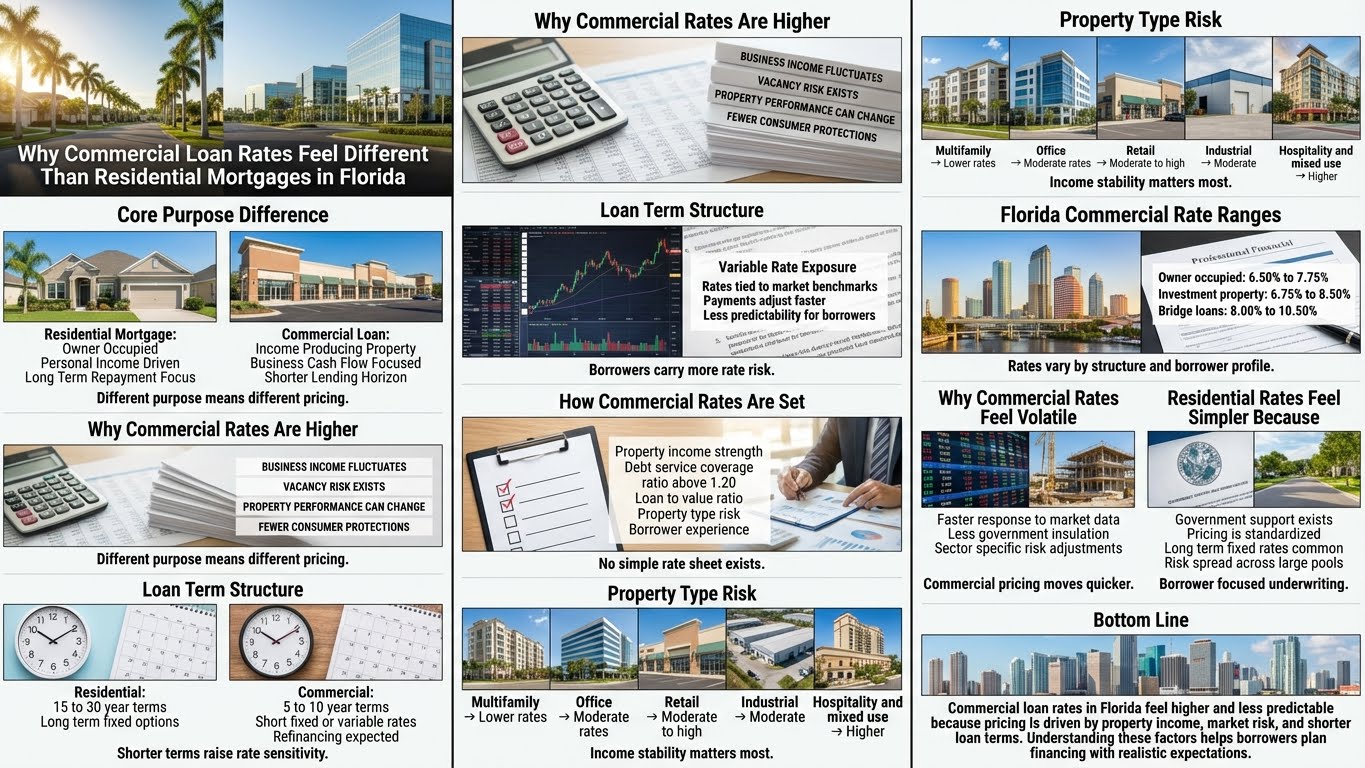
The basic difference between residential and commercial loans
Residential mortgages are designed for owner occupied homes. Commercial loans are designed for income producing property or business related real estate.
Residential mortgage purpose
Residential loans focus on:
- Borrower income stability
- Personal credit history
- Owner occupancy
- Long term repayment
Commercial loan purpose
Commercial loans focus on:
- Property income potential
- Business cash flow
- Market risk
- Shorter lending horizons
Because the goals differ, the pricing models also differ.
Why commercial loan rates are higher
Many Florida borrowers notice that commercial loans rates are often higher than residential mortgage rates. Several reasons explain this.
Higher lender risk
Commercial loans carry more risk for lenders.
Reasons include:
- Business income can fluctuate
- Vacancy risk exists
- Property performance can change
- Fewer consumer protections apply
Residential loans benefit from government support programs and standardized guidelines. Commercial loans do not.
Shorter loan terms
Most residential mortgages are structured over 30 years. Commercial loans typically use shorter terms such as 5 years, 7 years, or 10 years.
Even when amortization extends longer, the rate is usually fixed only for a short period.
Shorter terms increase rate sensitivity and refinancing risk, which raises pricing.
Variable rate structures
Many commercial loans real estate products use variable rates tied to market benchmarks.
These benchmarks move more frequently than residential mortgage pricing models.
As a result:
- Payments can change faster
- Rates feel less predictable
- Borrowers bear more interest rate risk
Less standardized underwriting
Residential mortgages follow standardized rules.
Commercial underwriting is more flexible but also more complex. Each loan is priced based on:
- Property type
- Location
- Tenant strength
- Lease terms
- Borrower experience
- Market conditions
This customization leads to wider rate ranges.
How commercial loan rates are calculated
Commercial rates are not pulled from a simple rate sheet.
Instead, lenders evaluate multiple factors.
Debt service coverage ratio
One of the most important metrics is the debt service coverage ratio.
This measures whether property income can support loan payments.
Typical expectations include:
- A ratio above 1.20
- Stronger ratios for higher risk property types
Lower coverage often means higher rates.
Loan to value ratio
Commercial loans typically require more equity.
Higher loan to value means:
- Higher lender risk
- Higher interest rates
- More conservative terms
Lower loan to value often improves pricing.
Property type risk
Not all properties are priced equally.
Property stability matters more than property value alone.
Borrower experience
Experienced investors often receive better pricing.
Lenders prefer borrowers with:
- Proven management history
- Strong financial statements
- Prior successful projects
First time investors often pay higher rates.
Why residential mortgage rates feel simpler
Residential mortgages feel simpler because:
- Government backing exists
- Long term fixed options are common
- Pricing is standardized
- Risk is spread across large pools
Borrowers qualify primarily based on personal income and credit rather than property performance.
Commercial loan rate ranges in Florida
Commercial pricing varies widely depending on loan type and structure.
Typical commercial loan rate ranges
Rates shift based on market conditions and borrower profile.
Why commercial loan rates feel more volatile
Commercial rates move faster than residential rates.
Reasons include:
- Tighter link to market benchmarks
- Less government insulation
- Faster lender response to economic data
- Sector specific risk adjustments
This volatility can feel uncomfortable for borrowers used to residential mortgages.
Commercial loans rates calculator limitations
Many borrowers search for a commercial loans rates calculator hoping for clarity.
While calculators can provide estimates, they cannot account for:
- Property income quality
- Lease strength
- Market vacancy trends
- Borrower experience
- Negotiated lender terms
Commercial pricing requires lender review.
Florida market factors affecting commercial rates
Local conditions influence current interest rate on commercial loans in Florida.
Key factors include:
- Office vacancy levels
- Retail performance by submarket
- Industrial demand
- Multifamily rent stability
- Local economic growth
Urban and suburban markets may price risk differently.
Why amortization matters
Many commercial loans use long amortization schedules with short rate terms.
For example:
- 25 year amortization
- 5 year fixed rate term
This creates:
- Lower initial payments
- Refinancing exposure later
Borrowers must plan for refinancing well before maturity.
Commercial loans versus residential loans comparison
This explains why pricing feels different.
Business commercial loans and real estate overlap
Some business commercial loans combine operating businesses and property financing.
These loans assess:
- Business financials
- Real estate value
- Cash flow stability
Rates are often higher because both business and property risks are involved.
When commercial loans make sense despite higher rates
Commercial loans still make sense when:
- Property income exceeds costs
- Appreciation potential exists
- Business growth supports debt
- Tax strategies favor ownership
Higher rates do not always mean poor returns.
Common borrower mistakes
Mistakes that increase cost include:
- Underestimating vacancy risk
- Ignoring refinancing timelines
- Overleveraging properties
- Assuming residential pricing logic applies
- Failing to stress test cash flow
Education reduces these risks.
How borrowers can improve commercial loan pricing
Borrowers may improve terms by:
- Increasing down payment
- Strengthening property income
- Improving tenant quality
- Building reserves
- Demonstrating experience
Preparation improves lender confidence.
Frequently asked questions
Why are commercial loan rates higher
They reflect higher risk and less standardization.
Are commercial loan rates fixed
Often only for short periods.
Can commercial rates go down
Yes, but they change faster than residential rates.
Do all properties qualify for the same rates
No. Property type and income matter.
Is refinancing common
Yes. Many commercial loans expect refinancing.
Final perspective for Florida borrowers
Commercial loan rates feel different from residential mortgages because they are designed for different purposes and risks. In Florida, where market conditions vary by property type and location, commercial pricing reflects income performance, market volatility, and lender exposure.
Borrowers who understand how commercial loans for property are priced, why rates fluctuate, and how lenders evaluate risk are better prepared to choose financing that supports long term success. Commercial loans may feel more complex, but with planning and realistic expectations, they remain powerful tools for property ownership and business growth.
Get a free instant rate quote
Take a first step towards your dream home

Free & non binding
No documents required
No impact on credit score
No hidden costs
.svg)
.svg)
.svg)
.svg)

.svg)
