
.svg)
Mortgage News
USDA vs FHA vs Conventional Loans: Interest Rates, Appraisal Rules, and Mortgage Calculator Differences Explained
Choosing the right mortgage loan is not just about qualifying. It is about understanding how different loan programs affect interest rates, appraisal standards, monthly payments, and long term affordability. Many buyers compare USDA vs FHA vs conventional loans without fully realizing how differently these programs work behind the scenes.
Each loan type is designed for a specific borrower profile and property situation. USDA vs FHA loans comparisons often focus on down payment requirements, but interest rates, appraisal rules, and mortgage calculator accuracy play an equally important role. Understanding these differences helps buyers avoid surprises and choose financing that supports both short term approval and long term stability.
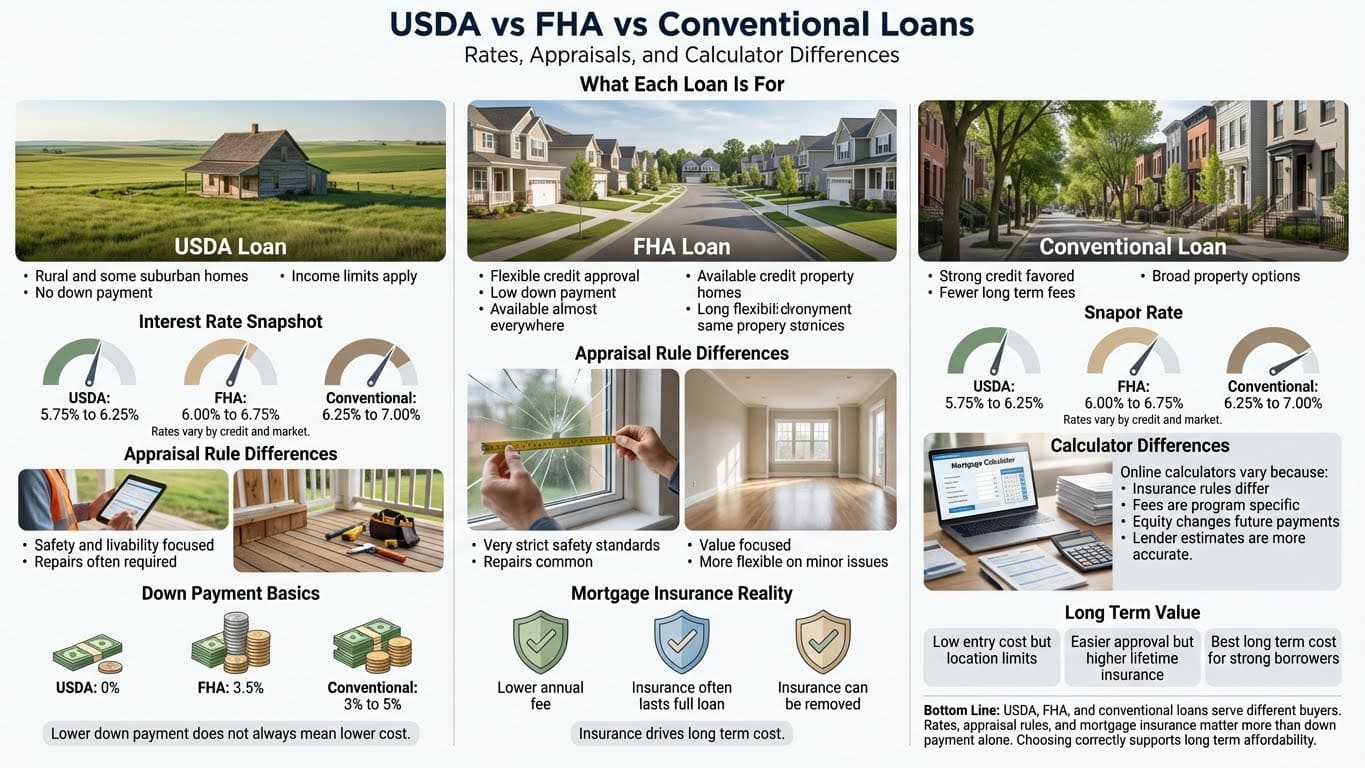
Overview of USDA FHA and conventional loans
Before comparing details, it helps to understand the purpose of each loan type.
USDA home loan
USDA loans are backed by the United States Department of Agriculture and are designed to support homeownership in eligible rural and some suburban areas.
Key features include:
- No down payment requirement
- Income limits based on household size and location
- Geographic property eligibility
- Lower mortgage insurance costs compared to FHA
FHA home loan
FHA loans are insured by the Federal Housing Administration and are designed to help buyers with limited savings or less than perfect credit.
Key features include:
- Low down payment requirement
- Flexible credit standards
- Available in most areas
- Mortgage insurance required for the life of the loan in many cases
Conventional home loan
Conventional loans are not backed by a government agency. They follow guidelines set by private investors.
Key features include:
- Broad property eligibility
- Competitive rates for strong credit borrowers
- Mortgage insurance can be removed with equity
- More flexibility for higher income buyers
USDA vs FHA vs conventional interest rates
Interest rates vary by loan type because each program carries different risk levels for lenders.
Typical interest rate comparison
Actual usda vs fha interest rates depend on credit score, loan size, down payment, and market conditions. USDA loans often have slightly lower rates due to government backing, while conventional loans reward strong credit profiles.
Why interest rates differ by loan type
Rates reflect:
- Level of government guarantee
- Borrower risk profile
- Mortgage insurance structure
- Market demand for each loan type
Lower rates do not always mean lower total cost when insurance and fees are included.
Appraisal rules and property standards
Appraisal requirements are a major difference many buyers overlook.
USDA appraisal requirements
USDA appraisals focus on:
- Property safety
- Structural soundness
- Basic livability
- Market value
Properties must meet USDA standards and be located in eligible areas. Repairs related to safety or habitability are required before closing.
FHA appraisal requirements
USDA vs FHA appraisal requirements often feel similar, but FHA is usually more detailed.
FHA appraisals review:
- Safety hazards
- Structural integrity
- Mechanical systems
- Health related issues
Even cosmetic issues may trigger repair conditions under FHA rules.
Conventional appraisal requirements
Conventional appraisals focus more on:
- Market value
- Overall condition
They are generally more flexible about minor repairs as long as the property is livable and safe.
Appraisal comparison summary
This is an important factor when purchasing older or fixer upper homes.
Down payment and mortgage insurance differences
Down payment requirements affect both upfront and monthly costs.
Down payment comparison
Mortgage calculator differences explained
Many buyers rely on online tools like usda vs fha calculator, usda vs fha loan calculator, or usda vs fha mortgage calculator to estimate payments. These tools are helpful but often incomplete.
Why calculators differ by loan type
Mortgage calculators vary because:
- Insurance costs differ significantly
- USDA and FHA include program specific fees
- Conventional loans remove insurance with equity
- Taxes and insurance estimates vary
A calculator that works for conventional loans may underestimate payments for FHA or USDA loans.
Why calculator results can be misleading
Most calculators:
- Use average insurance assumptions
- Do not reflect county specific taxes
- Do not include HOA dues
- Assume ideal credit profiles
Pre approval estimates from lenders are more accurate than online tools.
Income and eligibility differences
Loan eligibility rules differ significantly.
USDA income limits
USDA loans have strict income limits based on:
- Household size
- County median income
High income buyers may not qualify even with strong credit.
FHA income rules
FHA does not have income limits but focuses on:
- Debt to income ratio
- Stable employment history
This makes FHA accessible to a wide range of buyers.
Conventional income standards
Conventional loans favor:
- Higher credit scores
- Lower debt ratios
- Stable and documented income
They reward financial strength with better pricing.
Long term value considerations
Choosing between usda vs fha vs conventional loans requires thinking beyond approval.
USDA long term value
- Lower monthly insurance
- No down payment
- Geographic restrictions limit resale flexibility
FHA long term value
- Higher insurance cost over time
- Easier entry
- Often refinanced later
Conventional long term value
- Insurance can be removed
- Better long term cost for strong borrowers
- Higher entry requirements
Common buyer mistakes
Buyers often make these errors:
- Choosing based only on down payment
- Ignoring mortgage insurance duration
- Underestimating appraisal requirements
- Relying solely on calculators
- Not planning for long term ownership
Avoiding these mistakes leads to better outcomes.
How buyers should choose
Buyers should evaluate:
- Credit profile
- Income stability
- Property condition
- Location eligibility
- Time in the home
- Comfort with insurance costs
The best loan is the one that fits both current needs and future plans.
Frequently asked questions
Is USDA always cheaper than FHA
Not always. It depends on income eligibility and property location.
Are FHA loans easier to qualify for
They are more flexible for credit but have stricter appraisals.
Can conventional loans have low down payments
Yes, but mortgage insurance applies until sufficient equity is reached.
Do mortgage calculators show true payments
They provide estimates, not final numbers.
Can buyers switch loan types later
Yes. Refinancing can change loan programs.
Final perspective
Comparing USDA vs FHA vs conventional loans goes far beyond down payments. Interest rates, appraisal rules, mortgage insurance, and calculator accuracy all shape the real cost of homeownership. Each loan type serves a purpose, and none is universally better.
Buyers who take time to understand these differences, verify property eligibility, and review full monthly costs are more likely to choose financing that supports long term stability rather than short term convenience.
Get a free instant rate quote
Take a first step towards your dream home

Free & non binding
No documents required
No impact on credit score
No hidden costs
.svg)
.svg)
.svg)
.svg)

.svg)
